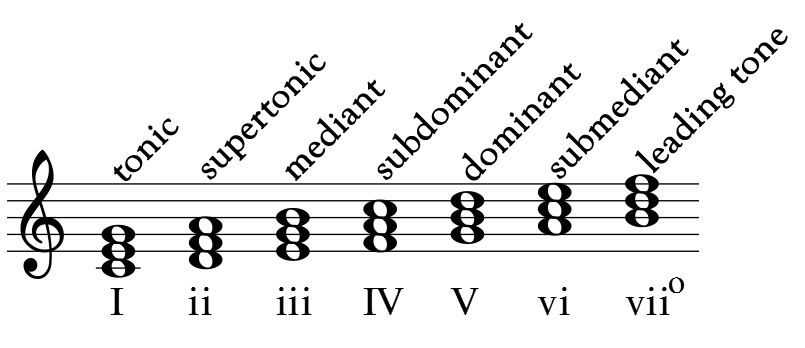
Note: This can apply to more areas of music than just piano, but piano is the most common because of the various chords played.
Scale Degrees – What Are They?
Scale degrees provide a standardized way to communicate intervals (distance between pitches) in a scale and to “see how those relationships shape musical structure and harmony,” says Google.
Scale degrees are important in piano especially because the names of the chords are commonly put above the sheet music as the scale degree “number” in Roman Numerals.
Scale Degree Names and Numbers
Note: These numbers apply for major keys only. Minor key names are discussed later in the post.
Tonic: The first degree in a scale, “do” on solfege. The building block for most chords. Roman Numeral: I (i, capitalized)
Supertonic: The second scale degree, “re” on solfege. Is notated as minor because the tonic, mediant, dominant chord formed from the supertonic is a minor chord. More later in this post. Roman numeral: ii
Mediant: The third scale degree, “mi” on solfege. Also written as minor for the same reason as the supertonic above. Roman numeral: iii
Subdominant: The fourth degree in a scale, “fa” on solfege. A perfect 4th up from the tonic. Roman numeral: IV
Dominant: The fifth scale degree, “so” or “sol” on solfege. A perfect 5th up from the tonic. Is used to create tension or to complete a V, V7 (V with a minor 7th), or I chord, most often. Roman numeral: V
Submediant: The sixth scale degree, “la” on solfege. It is a major sixth up from the tonic. Roman numeral: vi
Leading Tone: The 7th scale degree, the tone directly below the tonic, “ti” on solfege. Roman numeral: viiº7
The Different Distinctions Between Minor Keys
Note: Lowercase Roman numerals indicate minor, while uppercase indicate major.
A typical minor key is built off of a minor tonic (i), a minor supertonic (ii), a major mediant (flat [b] III, because even though the 3rd is minor above the tonic, the triad with the minor 3rd, 5th, and 7th forms a major chord), a minor subdominant (iv), a minor dominant (v) , a major submediant (VI), and a major leading tone (VII). But what if I told you that that’s only one of the three minor scale progressions in music?
The scale degree pattern that I described above applies to a natural minor scale, where the mediant, the submediant, and the leading tone are each lowered by one half step. It is the most basic and probably the most common minor key variation because of how simple it is to play. For example, in the key of “a minor” (the relative minor of C major, starting on the tonic a minor 3rd lower than C) you need only play white keys in the natural minor scale. That’s how simple it is.
However, there is another type of minor scale that raises the leading tone back to a diminished 7th instead of a major 7th. This scale is called the harmonic minor scale, and is called so because it enhances the harmony between the major V chord (by raising the 7th) and the other chords. The chord progression is i, iiº (diminished because the interval between the 3rd degree and the 5th degree is not diminished but minor), III+ (augmented chord, where the mediant and dominant are major but the leading tone is raised a half step, hence the harmonic minor), iv, V, VI, and viiº.
There is one more scale to note, and it is the melodic minor scale. The melodic minor scale raises the 6th and the 7th while keeping the 3rd minor. However, when the scale descends, it goes back to the natural minor progression to avoid sounding like the major scale until the one “rogue” minor 3rd. The chord progression ascending is I (because the raised 6th and 7th create a pull toward the tonic), ii, iii+ (minor but augmented because of the raised 7th), IV, V, viº, and viiº. The degree progression on the way down is the same as the descending natural minor scale.
If you would like me to go into greater detail on this subject or you’d like to hear about a topic that I haven’t touched on, please email me or comment below. As always, thanks so much for reading!
Cover photo by Music Stack Exchange







Leave a Reply