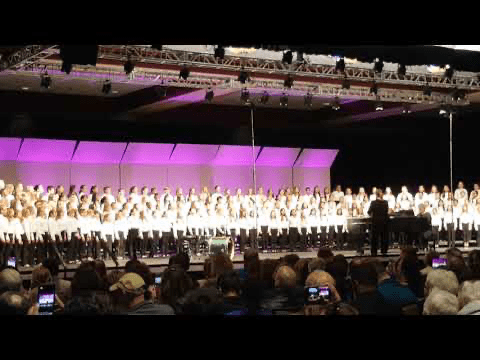
Today we will be looking at what the Florida All-State Chorus audition process is like and what you need to practice in order to do your best! (P.S: Congratulations to those who qualify for Vocal Quality or Sightreading Chorus!!! I found out yesterday (9/15/25) that I qualify for Sightreading Chorus, so everyone in VQ have fun and you’ll do great!!!)
Audition Process
All-State students are chosen by highest composite score, meaning that out of the 3 audition stages, your combined score for all 3 must be high enough to allow you into the chorus. Note: Sightreading Chorus in high school is for the top 25 scoring sightreaders from each voice part with a minimum of 80% correct on the theory test. You must also have a minimum of 30/40 measures correct for the sight-reading portion, though the cutoff is usually higher (this year’s cutoff was 37 measures, which made me barely qualify to get in because I did have 37 correct!). If you are chosen for Sight-Reading Chorus, you will skip Vocal Quality auditions.
Step 1, Day 1, September 9, 2025: Theory test. You will take a 50 question advanced theory test to assess your knowledge of music theory. You will fill out a bubble sheet with A, B, C, or D depending on the multiple choice answer, and on the side you will be given the student sheet which has the multiple choices for the questions on it. Almost half of the test is audio recorded, with you choosing the answer based on the audio that you’re listening to. When practicing at home, print out a 50-question bubble answer sheet or write down your answers (A, B, C, or D) on a piece of paper numbered with 50 questions.
Middle School Test Questions (newest version)
Questions 1-5: Rhythm Recognition (Recognizing if a rhythm is the same as what’s written on the student sheet)
Questions 6-10: Melodic Recognition (Recognizing if a melody is the same as what’s written on the student sheet)
Questions 11-18: Rhythm and Pitch (Recognizing if the tune and rhythm match what is written – there are 2 separate 4-measure exercises)
Questions 19 and 20: Chord Quality (Identification of major or minor chord)
Questions 21-23: Intervals (Recognizing the relationships between two pitches by hearing them and choosing one of the four options)
(AUDIO PORTION ENDS HERE, THE REST IS COMPLETED SILENTLY)
Questions 24 and 25: More Intervals (Recognizing the relationships between notes by seeing the intervals)
Questions 26-28: Key Recognition (Identification of key signatures)
Questions 29 and 30: Tonic (First note of a key) Recognition (Ability to recognize what “Do” is in a given key out of 4 choices)
Questions 31 and 32: Time Signatures (Recognizing if measures contain the wrong amount of beats – mark “A” if every measure has the correct number of beats, and mark “B”, “C”, or “D” if one of those measures has the incorrect number of beats. There will be 1 answer for each question.)
Questions 33 and 34: More Time Signatures (Ability to recognize what number is missing from the time signature based on the rhythms given)
Questions 35-50: Vocabulary (Understanding the different terms used in music by 15 random words on the vocabulary list)
At the bottom of the post I will link to my All-State blog posts and All-State official practice tests.
High School Test Questions (newest version)
Questions 1-5: Chord Quality (Recognizing if a chord is major, minor, augmented, or diminished)
Questions 6-10: Interval Recognition (Ability to recognize intervals, major, minor, perfect, unison, tritone)
Questions 11 and 12: Rhythm Recognition (Recognizing if a rhythm is the same as what’s written on the student sheet)
Questions 13-20: Rhythm and Pitch (Recognizing if the tune and rhythm matches what is written – there is one 8-measure exercise)
(AUDIO PORTION ENDS HERE, COMPLETE THE TEST SILENTLY IN THE SAME MANNER AS BEFORE)
Questions 21 and 22: Complete the Measures (Choosing the right rhythm to complete the measure based on the rhythm and time signature given
Questions 23 and 24: Time Signature Recognition (Ability to identify time signature based on the given rhythm)
Questions 25-32: Key Signature (Identification of major and relative minor key signatures)
Questions 33-50: Vocabulary (Recognizing musical terms and vocabulary)
Middle school minimum scores for advancing to second step
70-80 > 35-40 correct answers: SSA (Treble) Chorus
80-100 > 40-50 correct answers: SATB (Mixed) Chorus
High school minimum scores for advancing to second step
70-80 > 35-40 correct answers: SSAA/TTBB Chorus
80-100 > 40-50 correct answers: SATB (Concert) Chorus or Sight-Reading Chorus
Step 2, Day 1, September 9, 2025: Sight-Reading. If you got the minimum scores or higher for middle and high school, congratulations! You are now onto stage two, sight-reading! Sight-reading is taking a piece of music you’ve never seen before and reading through it. The All-State judges prefer if you use solfege, but if you get the solfege wrong or switch to a syllable like “Do”, “Dah”, or “Lah”, they will not mark you off. However, you may not hum. Pay attention to rhythms and notes. You get 1 redo for the entire audition, so use it wisely. Most judges will ask you to set up your key by singing the scale and arpeggio before you begin to look over your music and again before you sing through it.
Middle School Sight-Reading
Number of measures: 32
Exercises: 4 (8 measures each)
Key signatures: C, C, D, D
Time signatures: 4/4, 3/4, 4/4, 6/8
Minimum number of measures correct to advance: 8
Redo: 1 (If chosen to be used)
Time for each: 10s, 20s, 30s, 30s
High School Sight-Reading
Number of measures: 40
Exercises: 5 (8 measures each)
Key signatures: C, F, d harmonic minor (lowered 7th), D or G, C
Time signatures: 4/4, 4/4 or 3/4, 4/4 or 3/4, 6/8 or 6/4, 4/4 or 3/4 or 6/8
Minimum number of measures correct to advance: 10 (SSAA or TTBB), 20 (SATB), 30 or required cutoff for top 25 in each voice part (Sight-Reading Chorus)
Redo: 1
Time for each: 10s, 20s, 20s, 20s, 30s
Step 3, Day 2, October 7, 2025: Vocal Quality. After receiving your results for sight-reading, if you got the minimum or above, great work! You will now be given 5-6 pieces of music to learn over the course of the next few weeks. About 2 weeks into you figuring out the pieces, the All-State judges will release a portion of a random piece that you’ve been given to learn, and your job is to practice that portion until you can sing it without your voice part in the background (which is how it will be in the actual audition). You will also learn 2 vocalises, which are exercises sung on a particular syllable to warm up your voice. These will be in the audition as well and will be judged for points.
When you get to the school that you’re auditioning at, there will be 2 new excerpts from some of the other songs you learned, so you must be prepared and know your music well. Your audition, including vocalises, will be recorded and sent to the adjudicators for judging. Results usually come within a month. Minimum score for VQ based off the rubric: 114/285 (combined score from 3 judges)
After the audition, even if you pass VQ, you are not in the choir yet. Your composite (total) score from all 3 auditions must be high enough to get into one of the choirs. The selection results come in about a month after VQ auditions. If you make Sight-Reading Chorus, you will be chosen before VQ and will get your music when you arrive in Tampa in January for the concerts.
Helpful Tips and Sites
- All-State Past Musicianship Theory Exams (MS and HS – student, audio, and answers)
- All-State Past Sight-Reading Exams (MS and HS)
- Intervals (Beginner-Advanced) (MS and HS theory test)
- Key Signatures (Advanced) (MS and HS theory test)
- Tempo and Time Signature (Beginner) (MS and HS theory test)
- Florida All-State Vocabulary – Middle School (Beginner) (MS theory test)
- What is a Chord? (Beginner – Advanced) (MS and HS theory test)
- Florida All-State Vocabulary, Part 2 – High School (Advanced) (HS theory test)
- Make sure to drink plenty of water and get enough rest on the nights before the auditions.
- ALWAYS come prepared. You can practice with the resources above!
Thanks for reading! If I missed anything or if you have any questions, please comment on any of my posts. Come back tomorrow for SSACS and AACS!
If you liked this post, please consider sharing it with a friend who loves music and needs to go practice!!
Cover photo from YouTube

 The Happy Musician
Leave a comment