
(Comment below after reading this if you think I should do a video on this!)
Today you will learn what head, chest, and mixed voice are and when to use them. Let’s go!
Head Voice, Chest Voice, Mixed Voice
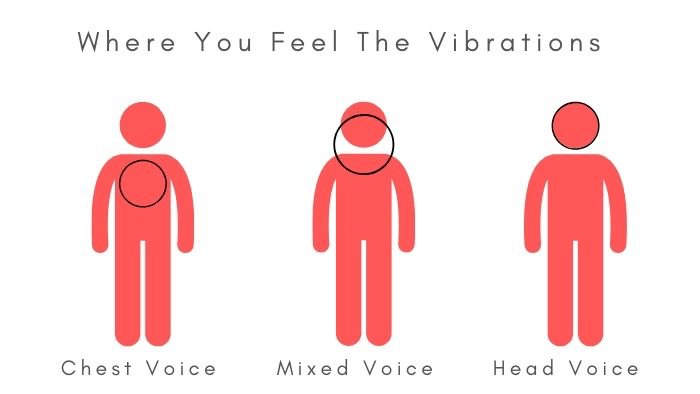
Head voice: Resonance is felt in the head and upper throat/voice tract. Head voice usually has a lighter sound and is better for high notes. It typically produces a rich yet bright sound if done correctly.
Chest voice: Resonance is felt in your lower voice tract and your chest. Chest voice usually has a darker, fuller sound, but it is almost only used for lower notes. When it is used for higher notes, it is called belting.
Mixed voice: This isn’t really a register, but it is instead a technique to make your passaggio from chest to head voice smoother without noticeable voice cracks. With mixed voice, you can go higher without having to strain your voice, unlike with belting incorrectly.
Passaggio: The transition notes from chest voice to head voice and vice versa.
Different Registers For Different Genres
Depending on the situation, most singing settings will use a certain vocal register (Head Voice, Chest Voice, occasionally Mixed Voice, if you even want to consider that a register). Here are the general registers for different music genres:
Pop: Most often Chest Voice or Mixed Voice
Choir: Head Voice
Musical Theater: It depends on the character, but Chest Voice and Belting are usually the most common.
Hip-hop: It can be hard to tell, but usually Chest Voice is used.
Gospel: Chest Voice or Belting
Country: Usually Chest Voice
Jazz: Almost every vocal register can be used depending on the song and artist, but Head Voice is probably the most common for a smooth jazz feel.
Thanks for reading! I hope you learned something! Go check me out on YouTube: @thehappymusician. See you on Thursday!
Post photo by How To Sing Better
Cover photo by MonkeyBusinessImages




 The Happy Musician
Leave a comment