
One thing that every singer in a choir must know is how to form beautiful vowels. Are you ready to make your A, E, I, O, and U sound more rich? Let’s go!
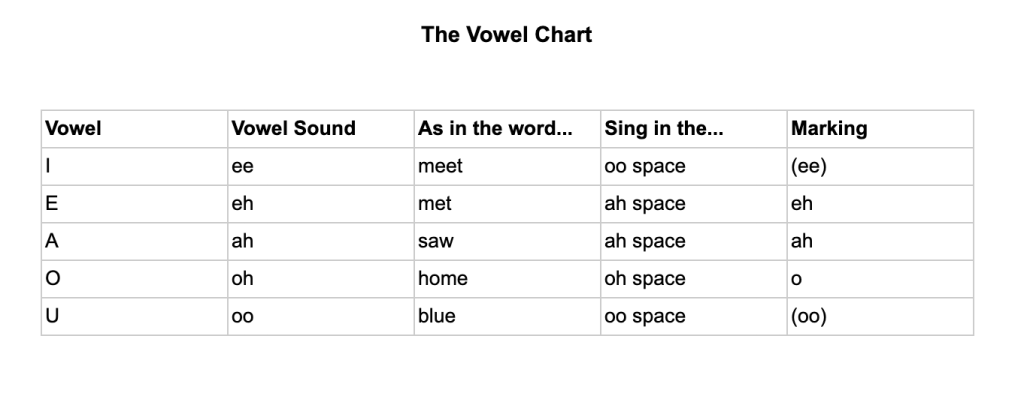
So many singers who have never sung in a choir setting are getting their vowels wrong. Sure, it might be okay if you’re in a setting like a Gospel choir or musical theater to spread your vowels, but if you’re in a church or school choir, the sounds of spread vowels will not blend. Here are the five main vowels in singing and how to make them mix well in a choir or chorus setting.
The five main vowel sounds in singing
- I (i), pronounced “EE”. This is one of the hardest vowels to get to blend and sound good in a choir because your mouth naturally spreads when you say any word with a double e sound. Try saying, “The street is full of buildings” without spreading your mouth on the words “street” and “buildings”. It’s hard, right? But with some practice, you can make the “i” (ee) vowel fit right in with the other singers in your choir. More about how to fix vowel sounds in the next section of this post.
- E, pronounced “EH”. (On occasion, i, pronounced “IH” or A, pronounced “AY”.) This is also a hard vowel to fit into a choir setting because it can sound so closed and boring, even lazy. You can still make this “EH”, “IH”, or “AY” blend, but this is definitely one of the less pretty vowels in any choir unless everyone sings it the correct way.
- A, pronounced “AH”. This is often considered the easiest vowel to sing in a choir setting because all you really have to do is raise your soft palate (the part near the back of your throat that you can feel go up when you yawn) and drop your jaw.
- O, pronounced “OH”. This is also one of the easiest vowels to sing in a choir. With a little practice, you will be able to sing the O vowel correctly in no time at all!
- U, pronounced “OO”. This is not an easy vowel, but it is not an extremely hard one. However, everyone must sing it the right way, or the sound is thrown off.
Shapes your mouth should make while singing the vowels
A picture of the pure (main) vowels in choir and tongue placement \/
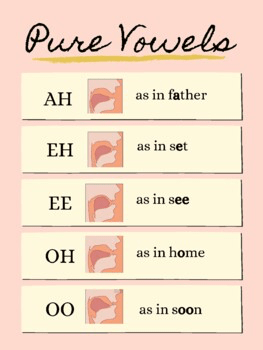
- I (i): Think more like “oo” or “oh” when singing this vowel. Say the “ee” sound but round your lips to make the shape of an o (with the corners of your mouth slightly tucked in), keeping space inside your mouth (more in next section). Your tongue should be touching the middle/back of the roof of your mouth.
- E: The tongue should be down in the mouth. Think “ah” or “oh” on this one – drop your jaw but not too far. Make sure that this vowel doesn’t spread by tucking the corners of your mouth in slightly.
- A: Drop your jaw and make sure there is plenty of space in your mouth. If you need to, gently pinch both your cheeks with your fingers and thumb to keep your mouth tall. Stretch your mouth tall enough so a clean sound will come out.
- O: Saying the vowel sound “OH” itself can help you form this pure vowel. Just be sure to keep plenty of space in your mouth and to hold your mouth position while still on the vowel sound. You can even tuck in the corners of your lips more to make a cleaner sound (which may sound closer to “oo”)
- U: Round your lips like you’re blowing out a candle. Keep plenty of space inside and make sure that the eraser of a pencil is the only thing that can fit in the space between your lips. You must do this right, or the whole sound will fall apart.
Some things to remember
- Don’t spread your vowels, as much as you may be tempted. Keep space in the mouth at all times.
- Imagine that there is an egg in your mouth that you can’t crack or swallow. This will keep space between your cheeks, teeth, and tongue.
- If that doesn’t work, place a Hershey Kiss or other semi-large candy (don’t choke on it or eat it!) on your tongue and try to say the vowels without the candy touching the roof of your mouth (except the “EE” vowel, but keep that one tall!).
- Drop your jaw. This will help the vowel not to spread out.
Beware the diphthong! – A final note
When you sing some words, they will have a vowel sound that is one vowel but sounds like two. This is called a diphthong. Some examples of diphthongs in words are smile, joy, and really anything that sounds like two vowels but almost always only has one vowel making the sound. Notice that if we took apart the word “joy”, it would sound like “Joi-ee.” In choir, singing a diphthong like this one will not blend, so here are two recommendations on how to make the diphthong sound less spread and more full and rich.
- Sing only the first vowel. On “joy”, it would sound more like “joh.”
- Sing the first vowel and put the second vowel as far into the note as possible. This means to sing the first vowel and only leave a hint of the second vowel at the end of the word. This is not advisable when singing higher notes, so you may want to stick with the first option when singing in a higher range.
Thank you guys for reading! I hope you learned something! Join me again for a surprise post soon!
Post photo 1 by Serene Vocal Studio
Post photo 2 by TPT
Cover photo by Pixabay


 The Happy Musician
Leave a comment