
This is just a side post, so don’t worry – there will still be the Arpeggio video post and Trumpet Studies. This is one of the basics of music that I have not covered yet, so now is a good time to mention it. Let’s get started!
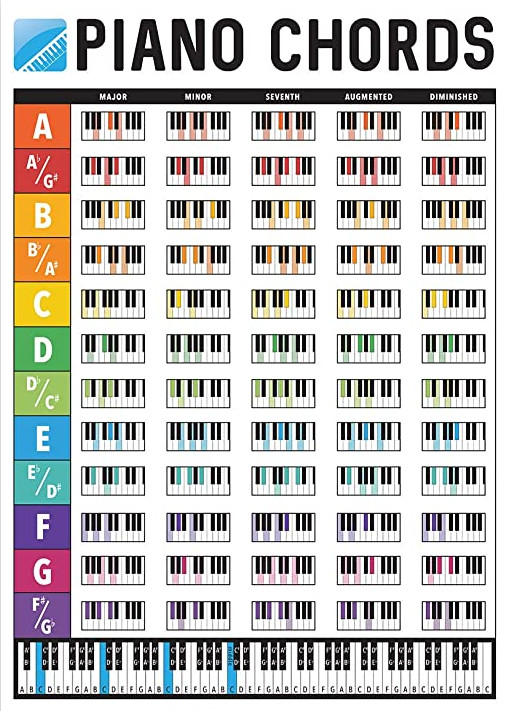
Above are all the chords and chord types you will get to know in this post. We won’t cover all of them, but we will cover the types of chords and the inversions of them. Here are the 5 main types of chords, and what they mean:
- Major. The major chord consists of a tonic (first note), mediant (third note, a major third up from the tonic), and a dominant (fifth note, a minor third from the mediant and a major fifth from the tonic). The major chord usually is meant to sound happy or light.
- Minor. The minor chord is built up with the tonic, the minor mediant (a minor third up from the tonic), and the dominant (a minor third up from the minor mediant and a major fifth up from the tonic.) The minor chord is meant to sound sad or melancholy.
We will ignore the 7th chord for now.
3. Diminished: The diminished chord is made up of the tonic, minor mediant, and the diminished 5th (tritone, major 4th plus one half step from the tonic). The diminished chord can be used to invoke feelings of mystery and secrecy.
4. Augmented: The augmented chord is made up of the tonic, the mediant, and the minor 6th (i.e. C to Ab). The augmented chord sounds like a major chord but with the raised 6th. It is used to convey feelings of surprise and shock.
Now that you know the chord types, let’s look at three of the most common chords. Once you know these chords, you can improvise many things on your instrument.
- I (1) chord. This is the basic major chord, consisting of the tonic, mediant, and dominant.
- IV (4) chord. This chord is the chord that consists of the tonic, subdominant (perfect 4th, all 4ths are perfect and so are fifths), and the dominant (5th tone).
- Gmaj (major) chord: This chord has the dominant, major 7th, and major 2nd (i.e. in C major, this chord would be made up of G, B, and D).
Finally, let’s explore the inversions of the chords. We will use C major for this because it is easiest to understand.
- C Major Chord: This chord is the normal major chord format, with the tonic (C in this case), mediant (E), and dominant (G).
- C Major 1st Inversion: This chord has the same notes as the C major chord, but in a different order and with different intervals. The first note of this chord is E, and it is a minor 3rd from the dominant and a minor 6th from the tonic. Next is G, which is a minor 6th from E and a major 4th from C. Finally, we have C as the top note.
- C Major 2nd Inversion: You guessed it – it’ll be the same notes but different intervals. We start with G. Then we go to C, which is a perfect 4th from the dominant. Lastly, E is the final note, which is a major 6th from the first note (G).
Note that all these chords can be played in any key, but C is the easiest example.
Thanks for reading! Please stay safe as Hurricane Milton hits the state of Florida. Praying for all of you who have been impacted by Helene and/or are about to be hit by Milton. Come back soon for the Arpeggio post and Trumpet Studies!
Cover photo by Cottonbro Studio
Post photo by Music to Your Home


 The Happy Musician
Leave a comment