Today we will look at the next two notes in the staff: F and G. We will learn a song that most of you have heard of (even though it’s not Christmastime yet). Keep reading for more!

For today, you are going to need one hand, preferably your right (sorry, lefties :0). Since you already know to put your thumb, second, and third finger on C, D, and E, why not put your fourth on F and your pinky on G? It’s simple. Place your Thumb on C and all the others should fall on the white keys up to G (See above image).
From that position, practice pressing all the keys from C to G without pressing any other fingers down. Remember to keep your wrist slightly elevated (maybe about half an inch higher than straight out) and relaxed and make your hands form a bubble over the keys. Once you play around with the two new notes, here is a song to try.
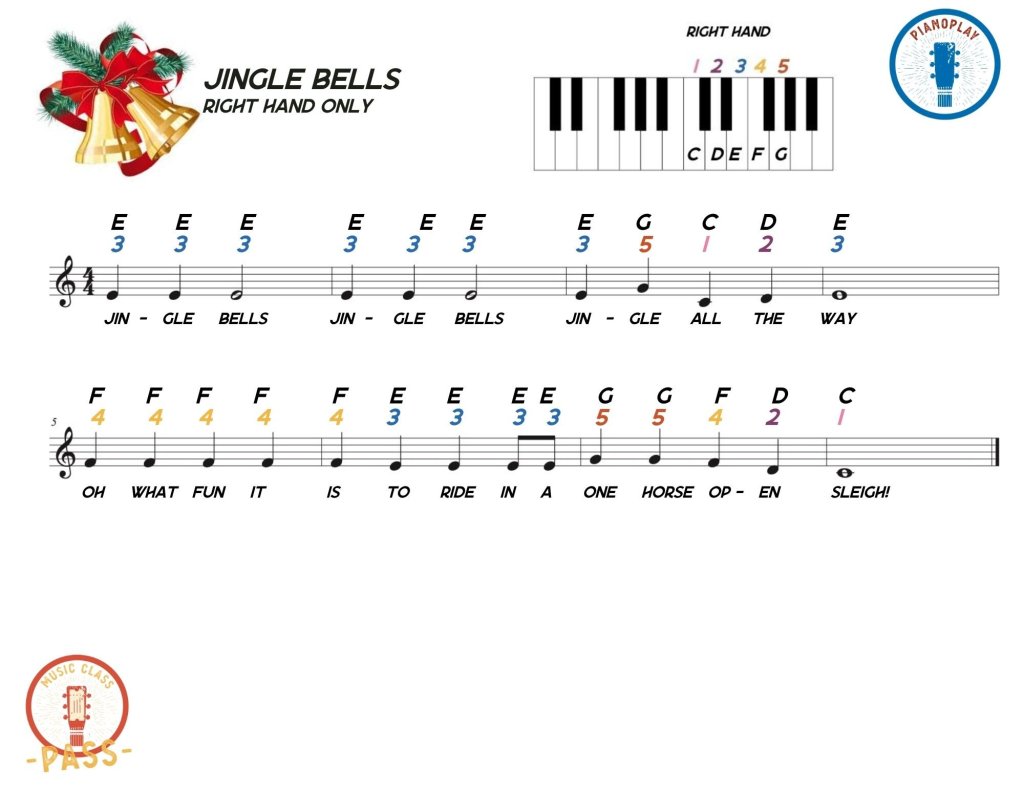
This song is very easy, and even has the notes and fingerings. Remember, look at the time signature and key signature before you begin. Here we have 4/4 time (four beats in a measure, quarter note gets one beat) and key of C (no sharps or flats unless indicated). Let’s start reading!
There are two lines, and these lyrics usually mean that this particular song is coming to a close. Here’s how to play.
Follow the fingerings given (you should only need the right hand to do this, though you may use the left. However, note that the fingerings will be backward for the left, so 1 is 5, 2 is 4, 3 is 3, 4 is 2, and 5 is 1).
If a quarter note (the filled in note with nothing attached to it) is one beat, and a half note (the note next to the second quarter note, not filled in) is two beats, then we would count measure one as 1 2 3-4, and measure two would be counted the same way. Measures one and two only have E, so use your third finger for those. Measure three is only quarter notes, but the notes change. The fingerings are 3 5 1 2 | 3 for measures 3 and 4 (the “|” is the measure/bar line). Measure four is four beats, so we count beat one and say the rest in our heads. Measure 5 is all quarter notes on F, so use your fourth finger to hit those.
Measure 6 fingers are: 4 3 3 3 3. This is the first and only time we see eighth notes in this song. We count the measure 6 rhythm like this: 1, 2, 3, 4&, but you can think the &s in your head as needed. Measure 7 contains the only G in this piece, so use your pinky to reach it. Measures 7 and 8 fingerings are as shown: 5 5 4 2 | 1. Measure 7 is all quarter notes (count to four on tempo) and measure 8 is a whole note, so count the first beat and say the rest in your mind.
Practice this over and over to get the fingerings down, and then move on to the next post (coming in a few weeks or this Saturday; I am alternating weeks for studies now but may bring back the three day a week posting). If there is any music tip (not studies) you would like to see posted, perhaps something you wanted to know about but I didn’t post, please let me know in the comment section. Thanks for reading!
Note: From now on I will still be doing posts twice a week, but because I can video, the posts may take a little bit longer to come out. Please stay patient as we work out this new journey into videoing.
Cover photo by Pedro Lucas

 The Happy Musician
Leave a comment