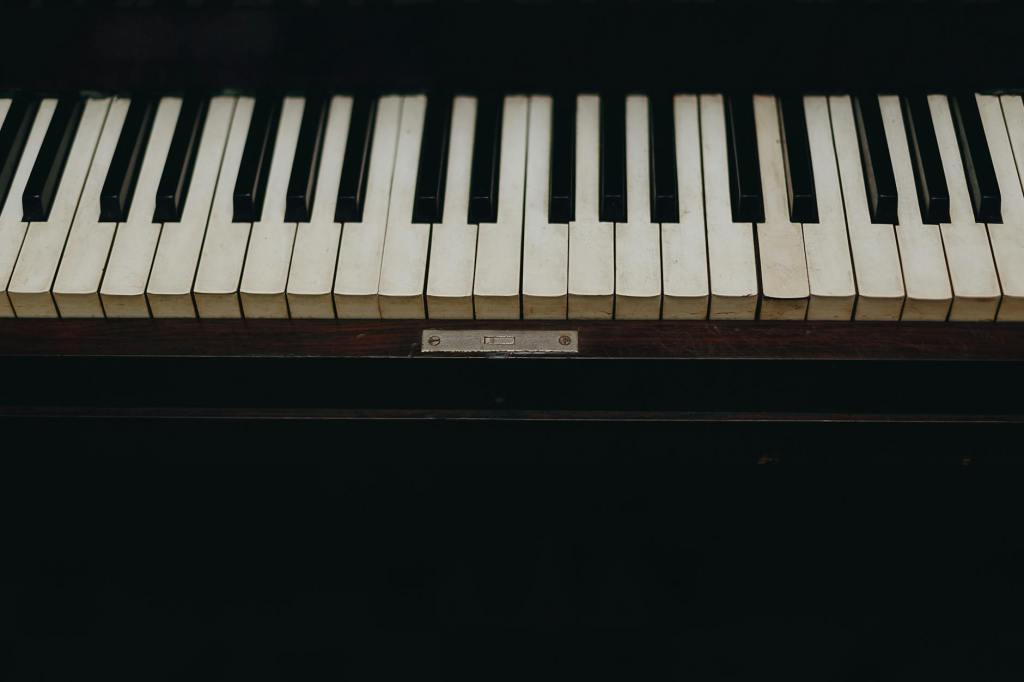
Today we will start our piano studies with the first three notes on the piano. These are the foundational notes that you need to know before you play any song. A picture of the piano keys is below. For this lesson, you only need to be focused on the first three white keys below.

If you look at the photo above, you will see three keys labeled C, D, and E. Note that C is often the starting note for a lot of instrument tuning, though some instruments are tuned to Bb, F, or Eb. Also note that C is the starting note, but A is not, even though it comes before C in the alphabet. This is because C is easier to find when looking at a keyboard, and it is much simpler to tell which octave you are in when you start with C (note: an octave on the piano is 8 notes from each note to the next note of the same name, i.e. C4 to C5). To play C, D, and E only, position your right hand with your thumb on C. Shown below is middle C, the main starting note for piano.
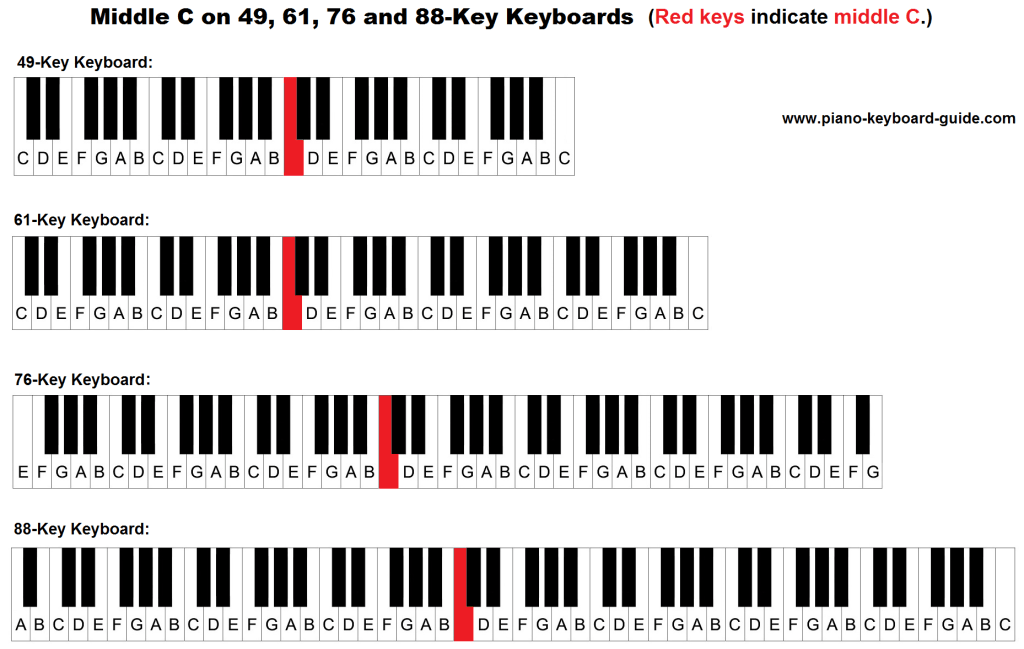
You can see above where middle C is on your keyboard type.
Start with your thumb on C and place your second finger on D (the white key next to C) and E (The white key next to D). Practice playing these notes in different patterns. I will use finger numbers for this to show some combinations you can try. Finger 1 is your thumb.
Here are some combinations to try with C, D, and E on fingers 1, 2, and 3: 321, 123, 231, 312.
Also try to add rhythm in when you are ready – start with whole and half notes, and then mix in quarter notes and eighth notes. See my second ever post for note and rest rhythms you can try in any time signature.
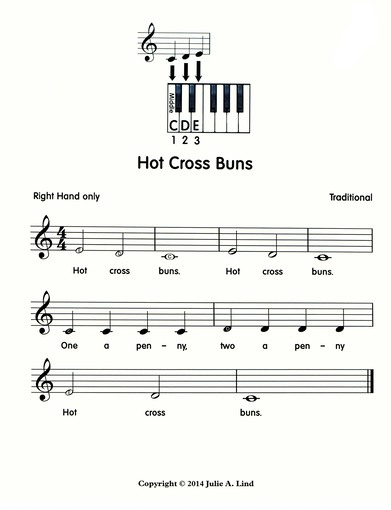
Down below is sheet music for a simple song you can try with these three keys. Practice this over and over until it is solid.
(Note: Check out my post “Notes and Staffs” to help you with reading this music.)
If you haven’t read my posts on staff lines and spaces and how to read music, I recommend you go back and read them now.
On your keyboard, use fingers 1, 2, and 3 and place your hands on C, D, and E. Now with these fingerings using the sheet music above (Half and whole notes) count in your head or out loud as you play this pattern: 321, 321, 1111, 2222, 321. Count: 1-2 3-4, 1-2-3-4, 1-2 3-4, 1-2-34, 1 2 3 4, 1 2 3 4, 1-2 3-4, 1-2-3-4. The “-” is between each number represents the tie between two notes. A half note is two beats so we count 1-2, 3-4, without saying the numbers after the hyphen out loud. For instance, a whole note would just be 1, but counted for four seconds or beats, or however you are keeping time.
Thanks for reading! Hopefully I can soon upload videos and show you what I mean by my posts visually! If you have any questions, leave a comment and I will do my best to answer your question. Thanks for reading, and I’ll see you on Thursday!
Cover photo by Karyme Franu00e7a
Post photo 1 by Piano Keyboard Guide
Post photo 2 by Piano Keyboard Guide
Post Photo 3 by Piano Song Download


 The Happy Musician
Leave a comment