
Today we will talk about how to stand in a rehearsal, audition, or performance setting. This is specifically for choir, but is really for any occasion. We will also talk a little bit about what is and isn’t professional in a choir setting in this post. Let’s hop to it!
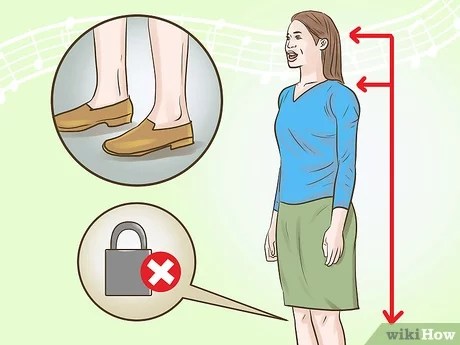
Above is a photo of how to stand in a choir. Let’s break it down step by step starting with the feet.
- Place your feet about shoulder width apart. If they are too wide or too close together, you will be unstable and unbalanced. One foot may be just barely in front of the other.
- Make sure your knees are always slightly bent. Don’t obsess over this (like I did at All-State this past year; I was determined not to lock my knees and go down :]) but make sure that your knees are never completely straight – failure to bend your knees or move may cause blood to pool in your legs and not get to other parts of your body, so you will most likely pass out. This is why choir directors tell their students to move slightly with the music – it makes you look happy and pleasant, but also prevents you from dropping to the floor onstage! It is especially important not to lock your knees on an elevated surface, like a stage, or risers.
- Keep your pelvis balanced on your abdomen. You should tuck your pelvis just slightly if you don’t feel the sensation of it balancing on your hips and lower torso.
- Keep your spine elongated. Don’t strain it, but keep it tall.
- Keep your rib, diaphragm, and lung area open. Do not let your spine collapse in on itself. This will block you from breathing properly. Make sure when you breathe your shoulders don’t rise and your stomach goes out. Your ribs should expand out as far as they can go in the front and the back.
- Keep your sternum lifted. Imagine a line running through your body that stacks everything on top of each other and lifts your chest up. Don’t make it forced and definitely don’t make it too obvious.
- Put your shoulders back. This may seem difficult because your sternum is going in the opposite direction as your shoulders. It will take practice, but it is considered good posture. Also let your arms hang at your sides where your hems are on your shorts, jeans, or skirt.
- Hold your chin up and just barely let your neck move forward. Don’t move it too far, however – this can close your throat and make your vocal cords not vibrate properly.
Now that we have addressed the proper way to stand, practice doing these steps one at a time. Bend over and imagine stacking your body parts on top of each other. Practice singing with the posture you were in before and then doing the stacking exercise again and singing with that posture. Can you hear a difference in the sound?
Finally, here are just a couple of professional and unprofessional things to consider while performing.
- NEVER clap for yourself. It is unprofessional, and can frankly come across as prideful, even if it’s not meant that way. Let others clap for you. If you are in an orchestra, instrumental ensemble, or band, and are sitting down, shuffle your feet for about 5 seconds to show appreciation or congratulation.
- If you are being judged and they must give you constructive criticism, take it and don’t argue. Don’t break down either. No one has “arrived” and all of us can learn something new at any time. Don’t think you know it all and are above everyone – this can cause you to get upset when you must take new criticism and apply it.
- If you are being judged and the judges are not allowed to criticize you, obey their directions. If you mess up, don’t show it on your face or with your stance. They are looking for professionalism and can see it in your emotions as well as hear it in your voice.
- If you have questions, let your judges, director, or overseer know at the appropriate time. For example, if you are in a Florida Polk All-County Chorus audition (Not necessarily Polk, but that’s just where I’ve had experience) and your folk song key that you must sing to pass the audition is too high for you (let’s say it is in C minor and the highest note is and Eb 5, aka the Eb a little more than an octave above middle C), you can let them know that it is too high and request a different key. For example, if the key is C minor, you might request A minor instead, and the highest note could go from Eb 5 to C 5. But you must let them know, because you know your voice better than they do.
Thanks for reading, and come back Monday for our first Piano Studies post!
Cover photo by Pixabay
Post photo by WikiHow





 The Happy Musician
Leave a comment