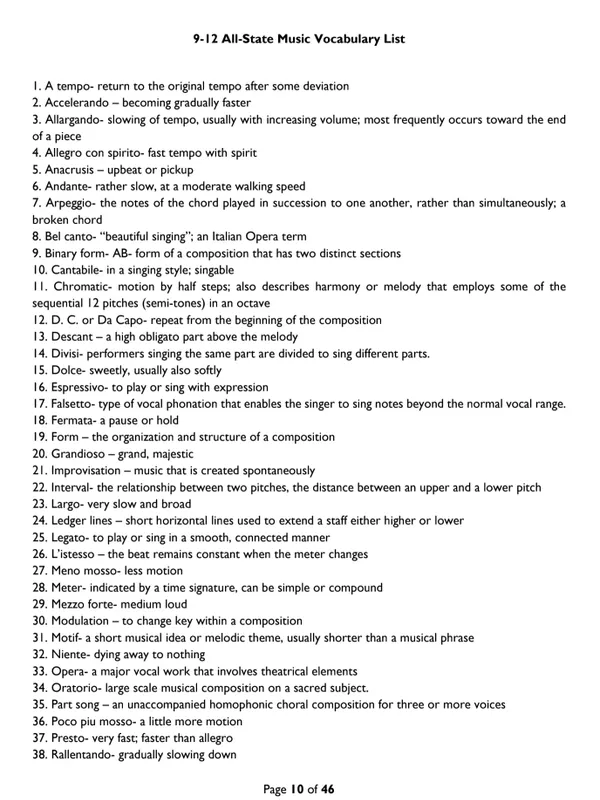
Today we’ll be looking at the high school terms for the Florida All-State stage one Musicianship (written) test. Don’t be surprised if some of the terms are the same as in middle school. Remember that only 15-17 of these terms will be used in a single exam, but it is still important to memorize all of them, especially if you did middle school All-State and are moving into high school. Terms that show up in the middle school will be marked with an asterisk (*).
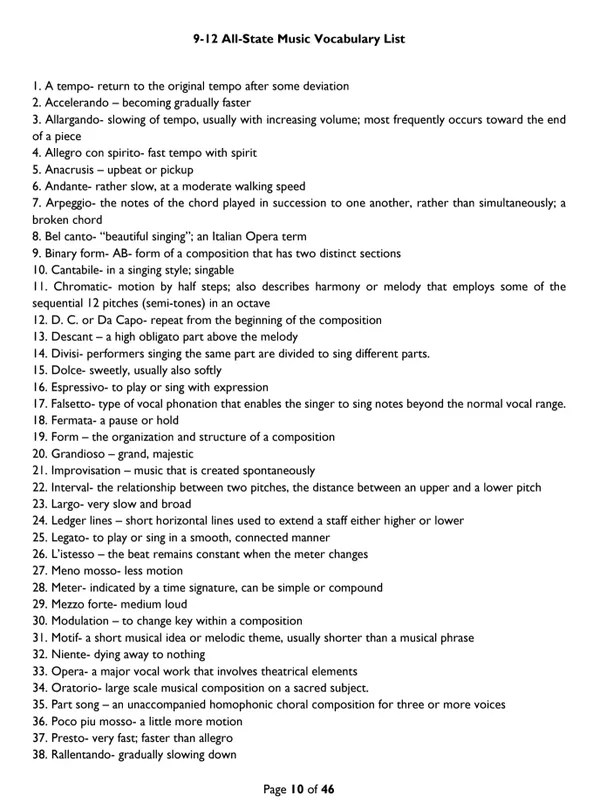
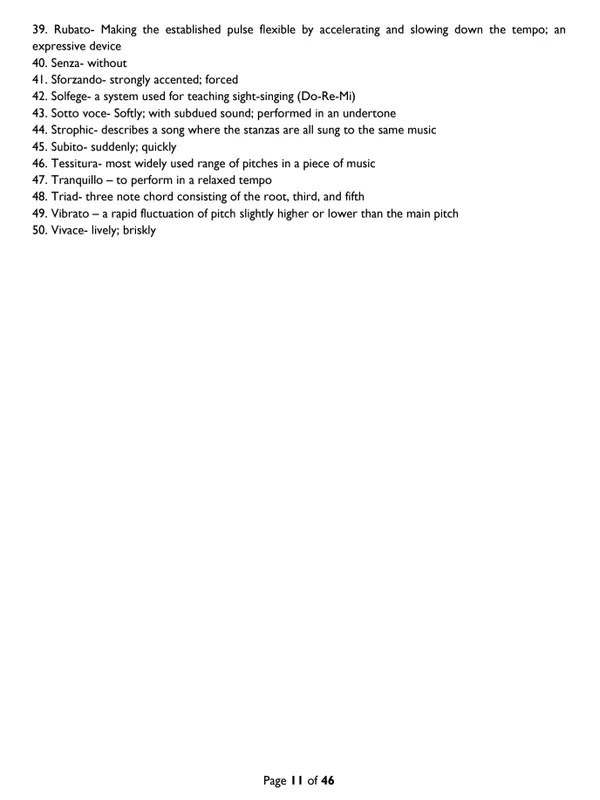
- *A Tempo: Return to the original tempo after any change in speed.
- *Accelerando: Gradually speed up.
- Allargando: Gradually slow down and crescendo (increase volume); usually happens at a climax or the end of a piece.
- Allegro con Spirito: Lively and fast, with spirit.
- Anacrusis: Pickup to a measure (Any note that does not fall on beat one, at the end of a piece the leftover value for the first measure is added to the last measure. Ex: If the pickup was on beat 3 in 4/4, then the last rhythm would be a quarter note, or one beat, to make up for it).
- *Andante: Regular walking tempo.
- Arpeggio: A broken chord, with the notes played separated, one after another.
- Bel Canto: Italian for “Beautiful singing.”
- Binary form: A piece that has two distinct parts, usually named A and B.
- Cantabile: Literally means “Singable.”
- Chromatic: A scale made up of every half note in an octave (sometimes more than an octave). Can also be a section of a song and doesn’t have to be the full octave in that case.
- D.C. (Da Capo): Repeat from the beginning.
- D.C. al Fine (Here’s a bonus term for you ;D): Repeat from the beginning and play till the “Fine” sign.
- Descant: A part written above the melody, usually higher than all the other parts.
- *Divisi: Performers on the same part are divided into separate parts.
- *Dolce: Sweetly, also typically softly.
- Espressivo: To play or sing with expression and phrasing.
- Falsetto: The vocal range that enables the singer to sing higher or lower than they normally would.
- *Fermata: Hold the note longer than you normally would; always watch your director or conductor when there is a fermata, they can hold it as long as they want!
- Form: The structure of a piece.
- Grandioso: Grand; often with an air of triumph.
- Improvisation (often called improv, for this we will just say music, though it could be acting as well): The making of music on the spot; spontaneously created music.
- *Interval: The distance between two notes on a staff.
- *Largo: Slow and drawn out.
- *Legato: Play or sing smoothly and in a connected manner.
- Ledger Lines: Lines through or sitting above or below notes that extend the staff.
- L’istesso: When the time signature changes the tempo stays the same.
- Meno Mosso: Less motion (often means to slow down).
- Meter: The time signature on a piece.
- *Mezzo Forte: Play or sing medium loudly.
- Modulation: A key change in a piece.
- Motif: A short segment of a phrase.
- Niente: Dying away until there is nothing left.
- Opera: A classical style of singing with many theatrical pieces and elements.
- Oratorio: A musical score that is a piece on a sacred subject.
- Part song: A type of choir/ensemble song composed for a group of three or more people.
- Poco piu mosso: A little bit more motion (refers to the tempo picking up speed just slightly).
- *Presto; Really fast, typically around 168-200 beats per minute.
- *Rallentando: Gradually get slower.
- Rubato: Changing of tempo for expression.
- Senza: Without.
- *Sforzando: Strongly accented on a particular note.
- Solfege: A musical device used for sight-reading and reading music easier (more in upcoming choir/vocal studies!)
- Sotto Voce: Performed in an undertone or near a whisper.
- Strophic: A song where all the stanzas of words or phrases are sung or played to the same music.
- *Subito: Suddenly; without warning.
- Tessitura: The most comfortable singing or playing range.
- Tranquillo: In a calm manner.
- Triad: A chord with three notes, consisting of the first note, third note, and fifth note of a scale (tonic, mediant, dominant).
- Vibrato: A rapid change back and forth from two pitches, so the voice sounds like it is lightly “shaking.” If you have vibrato (unless your voice is still developing), you are singing the right way.
- *Vivace: Lively and bright tempo.
I hope that you all learned something from this post even if you aren’t trying out for Florida All-State or live in a different state. Hope to see you guys at All-State auditions in September!
Upcoming Posts \/
Introduction to Choir/Voice Studies (Monday) (Beginner)
Introduction to Piano Studies (Wednesday) (Beginner)
Introduction to Trumpet Studies (Friday or Saturday – I start my co-op on Friday [August 9th] and continue throughout the school year every Friday) (Beginner)
See you guys on Monday!
Post photos by Florida All-State Prep
Cover photo by Thirdman

 The Happy Musician
Leave a comment