Today’s and Friday’s posts are for the Florida All State Musicianship exams questions 35-50 (For the High Schoolers, 33-50). If you reside in Florida and plan to audition for All-State Chorus 2025, this is the perfect post for you. Even if you don’t live in Florida or aren’t planning on auditioning for All-State, you can still learn some helpful terms from this post.
Note: Not all of these terms are used in one musicianship test.
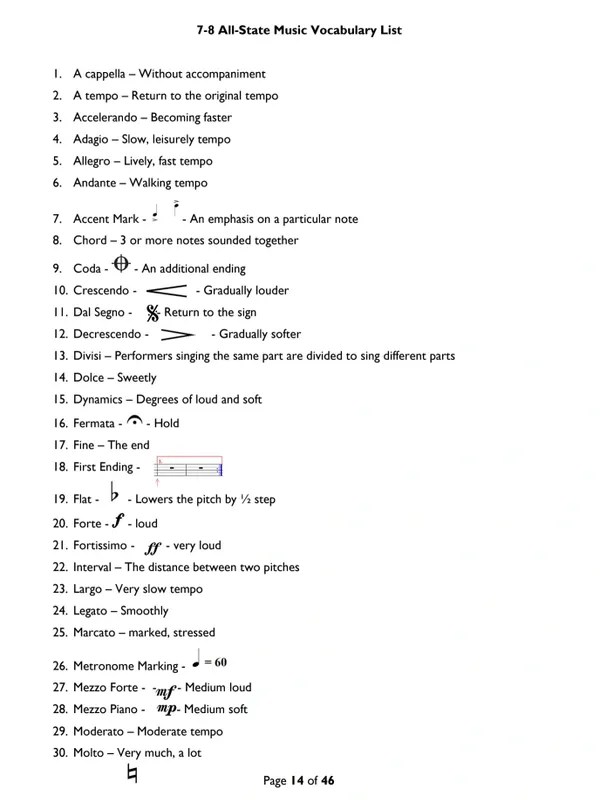
Let’s start with the first page. The terms are explained simply below even though the definitions are beside the terms already.
- A Capella: Without accompaniment; No background music or instruments.
- A Tempo: After a tempo change such as accelerando or ritardando. Meaning: Return the original tempo stated at the beginning of the piece.
- Accelerando: Gradually getting faster.
- Adagio: Commonly used in classical music; slow and leisurely tempo, a little like a slow walking pace. 66-76 BPM.
- Allegro: Commonly used in sonatas (Instrumental solo with multiple pieces, called movements); brisk and lively tempo. 120-156 BPM.
- Andante: Commonly used in symphonies; regular walking tempo. 80-108 BPM.
- Accent: Emphasis on a particular note with a symbol similar to this one over or under it: >.
- Chord: Three or more notes played or sung together; can be either dissonant (clashing) or consonant (pleasant and matching)
- Coda: An additional ending; sign looks a scope.
- Crescendo: Gradually get louder.
- Dal Segno (D.S.): Go back to the sign.
- Decrescendo: Gradually get softer.
- Divisi: Performers singing or playing in unison divide into harmonies and different parts
- Dolce: Sweetly, often light and soft.
- Dynamics: Letters that tell how loud or soft a song or section of a song is.
- Fermata: Hold the note longer than usual.
- Fine (FEE-nay, not “fine”): The end of a piece, usually after D.C. Al Fine (Return to beginning and play to the Fine).
- First and Second Ending: Play the song (or portion of the song) to the first ending. Then repeat the song (or section, as indicated by repeat bars), skip the first ending, and play the second ending.
- Flat: Lowers the pitch by a half step or semitone.
- Forte: Play or sing loudly.
- Fortissimo: Play or sing extra loudly.
- Interval: The distance or relationship between two notes.
- Largo: Slow tempo; think of it like a turtle or a sloth. 45-50 BPM.
- Legato: Smooth and connected; pitches are joined by a curved line under or over the notes.
- Marcato: Marked or emphasized. Looks somewhat like this: ^
- Metronome Marking: The BPM (Beats Per Minute) of a tempo.
- Mezzoforte: Play or sing medium loudly.
- Mezzopiano: Play or sing medium softly.
- Moderato: Moderate tempo. 98-112 BPM.
- Molto: Very much, a lot.
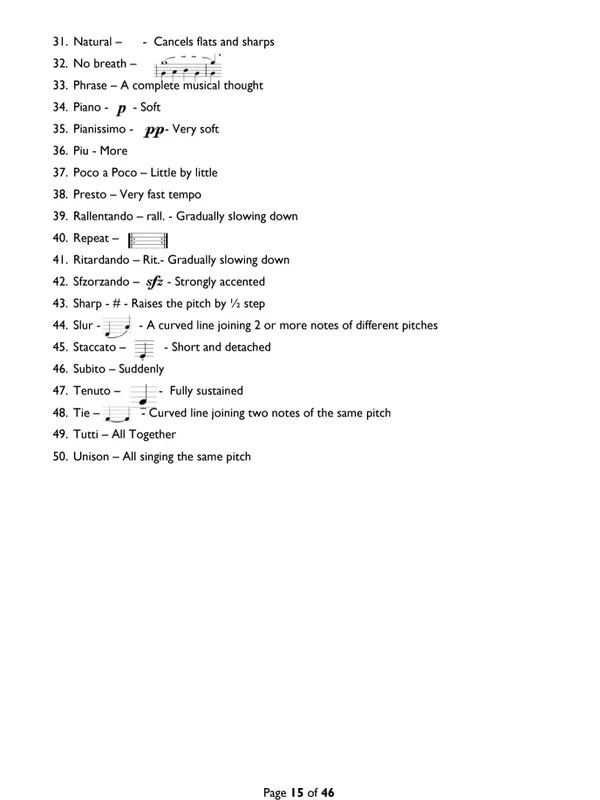
- Natural: Cancels accidentals.
- No Breath (NB): Typically a curved dashed line over or under a phrase indicating to keep going on the breath you already have. Sometimes music will have the words “staggered breathing,” which means to sneak a breath in while other people continue the phrase, and then jump back in while others are breathing.
- Phrase: Much like an English sentence, it expresses a complete musical thought.
- Piano: Play or sing softly. Also the name of a musical instrument that used to be called the Fortepiano before the name was changed.
- Pianissimo: Play or sing extra softly.
- Piu: More. Ex: Poco Piu Mosso means “a little more motion”.
- Poco a Poco: Little by little; gradually.
- Presto: Sprinting pace. 168-200 BPM.
- Rallentando (Rall.): Gradually slowing down in tempo.
- Repeat bars: Repeat the section or song.
- Ritardando (Rit.): Gradually slowing down in tempo.
- Sfzorzando (Sfz): Heavily accented on a particular note.
- Sharp: Raises the pitch a half step or semitone.
- Slur: A curved line joining two or more different notes; play or sing legato.
- Staccato: Shorter duration, looks like a dot under or over a note.
- Subito: Suddenly; without warning.
- Tenuto: Hold the note out for its full value.
- Tie: Curved line under or over two notes of the same pitch, takes both rhythms and puts them together.
- Tutti: Sing or play all together.
- Unison: Everyone sings or plays the same pitch.
These definitions will appear in the musicianship test for the first audition stage, so be sure to memorize these terms before the audition! Thanks for reading, and be sure to like and subscribe to this blog channel. Hope to see you at auditions in September!
Note: If you have already done All-State before, like me, you may already know what the process is like. Of course, it is always good to review (this goes for me too :D), especially if you’re going from middle school to high school.
Post photos and cover photo by Florida All-State Prep


 The Happy Musician
Leave a comment