
Today we will dive into intervals – what they mean and what the different intervals are. Let’s get started!
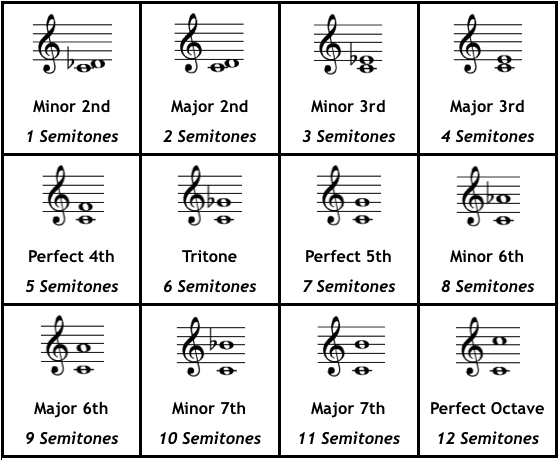
We have already learned how to read the different lines of a musical staff and how to use accidentals. All you need to know besides that is that the word “semitones” above means a half step.
An interval is how far apart two notes are. Major intervals have one more half step than minor intervals.
Note: All the above pictures start with the first note as C, but in different keys the tonic changes. For instance, if you changed the C at the bottom to a C# but kept the A the same it would become a minor sixth because you are essentially removing a half step by bumping the note up to C#. If, however, you only change the top, nothing happens except a new interval in the same key. If you want to change keys, change the tonic and the intervals will fall into place in that key signature. This doesn’t mean that C# to D# is not a major 2nd. Intervals stay the same numbers, but the notes change to give different intervals. I may make a post with all tonics in the future, but it remains unseen for now.
Let’s start with the first picture in the top left corner (we are going straight across each row, for the record). There is a C and a C#. There is no space between them, not even a key on the piano. This is a minor 2nd, and there is one half step between the tonic and the next note up (remember that the tonic is the base note in a scale or chord). The second picture at the top shows a C and a D. As you most likely know, there is a whole step between these two notes. This interval is a major second (also remember that a major second has one more half step than a minor second).
Now we see, in the third image, a C and an Eb (flat). Since we concluded that a minor second had no notes in between and D has one, we see that C to Eb has two: C# and D. We also know that after two comes three, and we have exhausted the two kinds of 2nds, so the next interval must be some kind of third. But what kind? As we recall from minor keys, the third note of a key is lowered a half step – that’s a main part of what makes a minor key minor! So we know that C to Eb sounds like – and, in fact, is – minor. The interval here is a minor third.
On to the fourth picture, where there is a C and an E. From a few posts ago, we can use the major scale formula to find whether this is an extra half step or an extra whole step. The major key formula is: Whole, Whole, Half, Whole, Whole, Whole, Half. We need the other type of third, so we look at the piano keys. C to D is a whole step and D to E is a whole step. Two whole steps up from the tonic always make a major third. A major third can be on two adjacent lines or two consecutive spaces.
The fifth picture shows what is called a perfect fourth. All fourth and fifth intervals are called perfect intervals because of their consonance in music. A perfect fourth has 5 half steps, not including the C at the bottom. In this case, the notes are C and F. The next picture shows a tritone. A tritone is just a raised fourth, and in this example it is a C to an F#. Tritones are commonly used in diminished chords, where the major third becomes a minor third, and the perfect fifth becomes a diminished 5th (which is a tritone, one semitone lower than a perfect fifth). It used to be called the “Devil’s Interval” because it was surprising and unpleasant to listen to. The next interval is a perfect fifth (because all fifths are perfect), and it has 7 half steps excluding the C.
The last picture on row two is a minor 6th. The minor 6th is commonly used to darken tones, or occasionally end a piece, depending on the major key the piece is in. This interval is used in augmented chords, where the 5th is raised a half step. In this example, the keys are C and Ab (or G# if you prefer).
In the next picture in the bottom left corner, there is a C to an A. Without looking at the image, try to count (besides the C) how many whole steps and half steps there are to figure out the interval, major or minor (Hint: There are four whole steps and one half step. Count from C using those. To get you started, one whole step is from C to D. Now find out the other three and a half whole steps and find out the relation of the top note to the bottom note). The answer is at the bottom of the post.
The second photo on the bottom shows a C and a Bb. This interval is a minor 7th and has 10 half steps between it and the C (excluding C, of course). It is minor because the seventh is lowered a half step from what it would normally be, which brings us to our next to last image, the major seventh with eleven semitones. The major seventh is, of course, a half step higher than its counterpart, the major seventh. It is major because there are no accidentals to raise or lower the pitch from its natural state.
Finally, we have the perfect octave, which is the same note but twelve semitones higher than the lowest note. It sounds just the same as the lowest note but is at a higher sound frequency.
I hope you guys enjoyed and learned something from this post. If you are planning to audition for the Florida 2025 All-State chorus, this will help greatly with the first stage of audition: the musicianship test. Vocabulary for that is coming out on Wednesday and Friday (Middle School on Wednesday, High School on Friday). After that, I will be thrilled to introduce the all new individual music studies – piano, trumpet, and singing (note that the singing is more like choir than voice and musical theater, sorry for any inconveniences). French horn may be coming about a semester or so from now, so stay tuned and make sure to subscribe to be able to know when the next instrument study is coming out. Thanks for reading and I will see y’all Wednesday for All-State practice!
By the way, the answer for the bottom left corner is 9 half steps and a major 6th!
Post photo by ToneGym
Cover photo by Skitterphoto


 The Happy Musician
Leave a comment