
Today we will be taking a look at relative minor keys (keys that go hand in hand with the major keys) and enharmonic notes, which are notes that sound the same but are written differently. Let’s go!
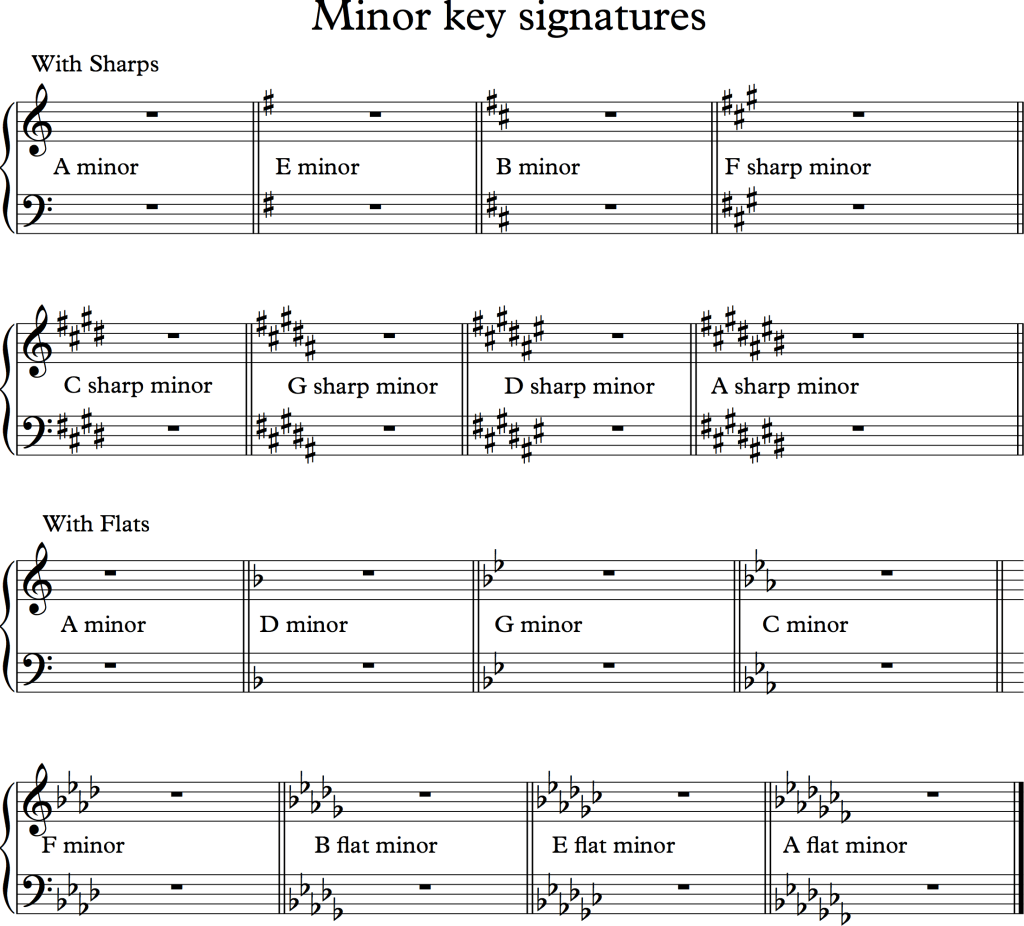
Just as we looked at the major keys, there are relative minor keys. Let’s take a peek at how we figure out what minor keys are and how to find their key signatures.
First of all, a natural minor key is the same as a major key but with the third note in the scale lowered by a half step. A harmonic minor scale has the same notes as a natural minor key but the seventh note of the scale is raised a half step. Finally a melodic minor key is the same as the harmonic minor scale but in addition to the lowered third and raised seventh the sixth note of the scale is raised a half step.
Now that we know that, we can start determining the key signatures above.
The first one in the sharp and the flat section in the image has no sharps or flats. This is the key of C major. To find the minor key, we need to go down a minor third, or 1 and a half steps down (excluding C). We can either count one line and space down, count four half steps including the first note of the particular major scale, or count up to the sixth note in the major scale to find the relative minor key.
These techniques are hard to do with C, so you’ll have to memorize this one. The minor of C major is A minor.
Now let’s look at the second key signature in the sharp section. As we may remember from yesterday’s post, the key with one sharp is G major. We can count down from G 3 half steps. We count G to F#, F# to F, and F to E. Our relative minor key is E minor. We can easily see from here that the key with two sharps is D major and we need to count one line and one space down. The line down is C and the space down is B. Therefore, the minor key is B minor.
With the key that has three sharps, A-major, I will demonstrate the last method I named earlier. A thing I may have forgotten to put into my key signature post is that the last sharp on the right is the seventh note in an 8 key typical scale. This note is a half step down from the tonic or first note of any scale. The seventh note is called “Ti” in a notation called solfeggio, or solfege. More on that soon, when the vocal studies come in a couple of weeks. We need to find the sixth key in the scale in order to find the base for a minor scale. All we need to do is know the notes in a key signature and find out the sixth note. The notes in the key of A major are as follows: A, B,C#, D, E, F#, G#, and back to A. Now we must find the sixth note in that series. We count: A, B, C#, D, E, F# – wait. F# is the sixth note in the scale! Therefore the relative minor key to A major is F# minor.
The key with four sharps, E has a relative of C# minor because we can count E, Eb, D, and C#. The five-sharp key, B major, has a relative of Ab (flat) major. We can count like we did with the key of E: B, Bb, A, Ab. Thus, we have the key of Ab minor.
Try to guess what the six-sharp key (F# major) is using the counting down method. The answer is at the bottom of this post.
The last sharps key is C# major. Let’s count the notes in this key signature, with seven sharps: C#, D#, F, F#, G#, A#, C, and C# again. Now we count 6 notes out of 8: C#, D#, F, F#, G#, A#. Our new minor key is Bb minor.
Now let’s use the “two step counting down” or the “line and space” methods for the flats. The second key in the flat section is F major, so if we count down a line and space we get D. The key is D minor. For the next key, B flat major, we count: Bb, A, Ab, G. The key is G minor. The fourth key with three flats (Eb major) has a relative minor of C# major. Try to guess what the minor with four flats (Ab minor) is. The answer is at the bottom of the post.
The five-flats key (Db) has a relative of Bb minor. The six-flats key (Gb) has a relative of Eb minor. Lastly the seven-flats key (Cb, or B) has a relative minor of Ab.
You may be thinking that some of the flat keys had the same minors as the sharp keys. This is where alternative notes, or enharmonic notes, come into play. There is always more than one name for a key as long as it’s not a natural note (the exceptions are Fb [E], E# [F], B# [C] and Cb [B]). For instance, you can call C# Db and it would mean the same thing. The main difference is when you use the names. For example, in a key made of sharps you could call Db C# because the key is made up of sharps. Likewise, you could call C# Db in a key made of flats because it would be more appropriate. In the natural key of C, either name will do.
I hope you learned something! Come back on Monday for a new post! Answers for the questions up there /\ are down here. \/ Bye!
Answer for six-sharps key: Eb minor
Answer for four-flats key: F minor
Post photo by Music Theory for Beginners
Cover photo by Teddy Yang


 The Happy Musician
Leave a comment