Today we will be talking about key signatures, which just means the key that you play specific notes in. Let’s discover how to find key signatures and what key signatures actually are. Let’s get started!
Note: If you have not read my previous post, Accidentals, now would be a good time to get caught up.

A key is, as defined by Google, “The arrangement of sharp or flat signs on particular lines and spaces of a musical staff to indicate that the corresponding notes, in every octave, are to be consistently raised or lowered from their natural pitches.” This means that for every key signature, the flats or sharps make the lines or spaces that they are on flat or sharp for the whole piece, unless indicated by an opposite accidental (i.e. Natural, sharp for a flat, flat for a sharp).
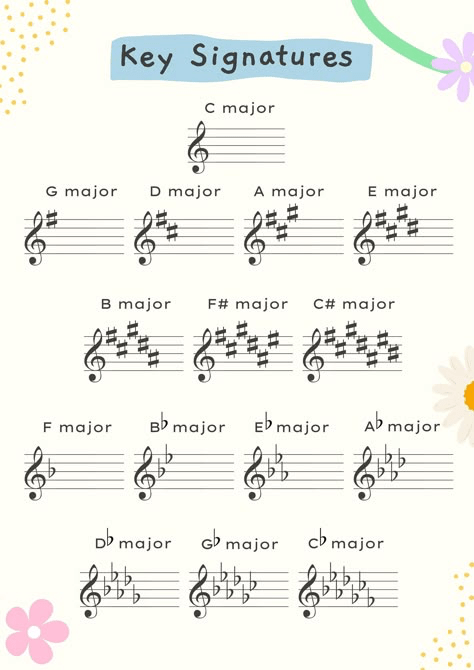
Let’s take a look at the flats first. The first key above has one flat on the B line. This makes all B’s in this key signature flat unless otherwise indicated. There are two tricks to keep in mind for finding out what key signature the first one above is. The first trick is to go to the last flat and count down four steps, including the line the flat is on but excluding accidentals. In this case, that would be B, A, G, and finally, F.
The second method requires some effort and memorization, but the alternative way to count flats is to look at the flats that are on the line in order. The key with all the flats would have them on the following lines and spaces: B, E, A, D, G, C, and F, in that order. Now, following this rule, we can go back to the second to last flat and find out the key.
But wait – we only have one flat! No worries, this method is still possible. Using the order, the first flat is B, as seen in the image. The second to last flat is, in this case, the last flat in the key with all the flats. If you missed what I did, I went backward from B to F. Think of it in this order: BEADGCFBEADGCF. You can just go backward from the B to the F! The first key is the key of F, and all B’s are flatted in this key. Just remember that if there is one flat, it is ALWAYS the key of F major or D minor (more on relative minor keys and note notations in an upcoming post)
On to the second key, which now has two flats. Remember, we can go to the second to last flat and use the specific key order to determine which key this is. The order is “BEADGCF,” so if we go “B, E,” and go back one flat, that is B flat, so that is our key. In B flat, all B’s and E’s are lowered a half-step.
The third key (obviously) has three flats. If we know that in the key with two flats that B’s and E’s are flatted, we only need to find the last flat. If we remember the order, we know it goes “BEA,” so our last flat is A flat. Now we just need to use one of the two methods to find our new key. I will use the first to show you how to do it. In some ways, this method can be easier. Let’s go to the A (which is now A-flat) and count down four steps. If we do this, we end up with A, G, F, and E. Therefore the final key is E-flat, and all B’s, E’s, and A’s are flat.
One final way to tell the next key (four flats) is to simply look at the last flat on the right. Then, when you add a flat, that becomes your new key. For instance, with our three flats we had B, E, and A. The last flat is A, so when we add a flat (D, in this case) our E-flat becomes A-flat.
Now for our fifth key, with (no way!) five flats. The order is BEADG, so if we go back a flat, we will see that our key is D flat.
See if you can guess what the key with six flats is by using either of these two methods (answer at bottom of post).
Our last flat key has seven flats (BEADGCF), so let’s go back one letter and get C-flat, which is simply just B. All of these notes (BEADGCF) are flatted in this key signature.
Now let’s move on to the sharps and the key that has an exception to both sharps and flats. There are two ways to count sharps. One is to look at the last sharp and go one half step up. The other is like the flat pattern, but it is backward! The following is the pattern: FCGDAEB. The rule for this is to count the last sharp on the right and go two sharps forward in the pattern.
Let’s look at the second key above, which has one sharp. I will show the first method on this one, and then on the next I will demonstrate the second method. For this key, we only need to go a half step up from F# which is just G. The key is G, and every F is sharped in this key. This is not like the flats, where each key is called by a flat. Rather, some keys in the sharp signatures are called by their natural names, and some are not. This is because if the tonic of the key, otherwise known as the first note in that key’s scale (more later), does not have a flat or sharp on it in the key signature, the key goes by its natural name.
The third key has two sharps. Using the order “FCGDAEB” we can skip two sharps in this pattern from the last sharp. The last sharp is C sharp, so counting in the pattern from after C we go, “G, D.” Therefore, the key is D major.
The fourth key has three sharps and the last sharp is a G sharp. If we go up one half step from G sharp we get the key of A.
Try to guess what key the fifth key (with four sharps) is by using either of these two methods. The answer is at the bottom of the post.
The sixth key has five sharps, and if we count five sharps in the pattern we get FCGDA. Now we skip ahead two, and that gives us FCGDAEB. Therefore, the key is B major. The seventh key has six sharps, so we count FCGDAE. Then we skip two, which is B, and then we repeat with F again, so the key is F-sharp major.
The last key has seven sharps, and from the pattern we know that the last sharp is B-sharp, or C natural. If we go up one half step from there, we get C-sharp major.
The one exception to these rules is the key of C major, which has no sharps or flats.
Oh, and by the way, the answers for the keys are down below.
Answers \/
Six flats key: G-flat major
Four sharps key: E major
Thanks for reading, and I hope you learned something today! Make sure to leave a like and a comment if you enjoyed! See you Friday!
Post photo by Music Getaway
Cover photo design by JessAU on Pinterest
 The Happy Musician
Leave a comment