
Today is my last post before I go on vacation, but I will resume posting on Monday, July 22, 2024. Today we will talk about some music terms and what they mean. This doesn’t include the Florida All-State vocabulary list, but that will be in a later post, for those wishing to do Florida All-State auditions in September (I do not know how other states do their All-State, so if you don’t live in Florida your auditions may be at a different time than if you do live in Florida).
Key: A=Advanced, B=Beginner.
Let’s get started!
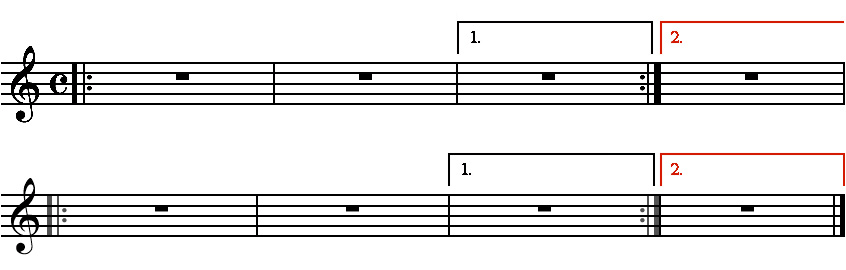
First and Second Ending (A): Follow the repeat sign and go to the other repeat, which is in the measure with the bracket over it that says “one.” Then, the second time through, go back to the first repeat sign, go to just before the first ending, skip the first ending, and go to the second ending bracket. From there you would play what’s inside the second ending bracket and move on or end the song from there. The image above shows a single bar line at the end on top, and a double bar line at the end on the bottom, meaning to keep going on top and drop down to the bottom line. Then you would end on the bottom.
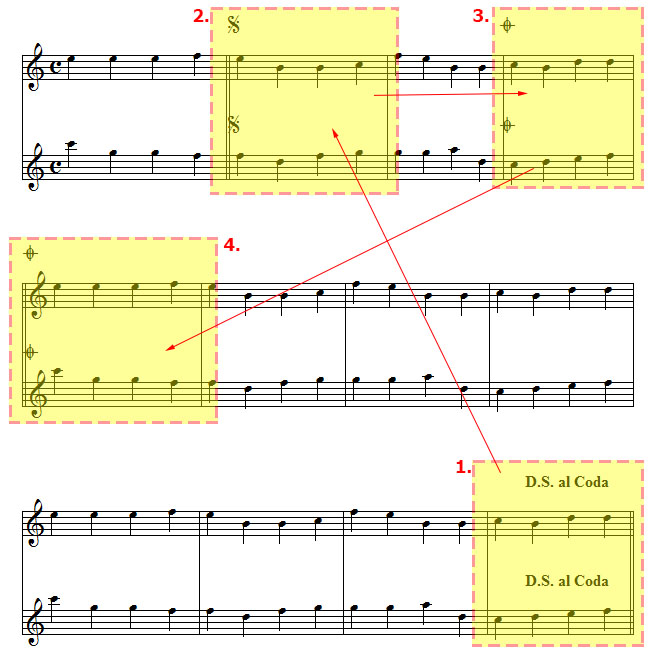
Dal Segno (D.S.) and Coda (A): Play or sing the whole song through, including any repeats and first/second endings. When you see the “D.S. al Coda” (Which means “back to the sign and to the coda”) go back to the S-shaped sign with the straight line and dots and play from there. Then go to the coda on the top line (in this case), the sign that looks like a scope, and find the next coda down. Play from there until the double bar line, which signals the end.
Ritardando (Rit.), Accelerando (Accel.) and Rallentando (Rall.) (B): Ritardando and Rallentando mean to gradually slow down. Accelerando is the opposite, meaning to gradually speed up.
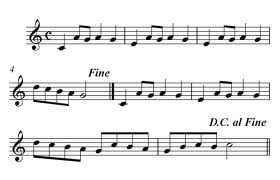
D.C. al Fine (D.C. al fee-NEH) (B): Play through the song until the D.C. al Fine. Then, go back to the beginning of the song, play through it, and end where it says Fine.
8va, 8vb, and 15ma (B): 8va means to play an octave higher than written. 8vb is to play an octave lower than written. 15ma means to play two octaves higher than written.
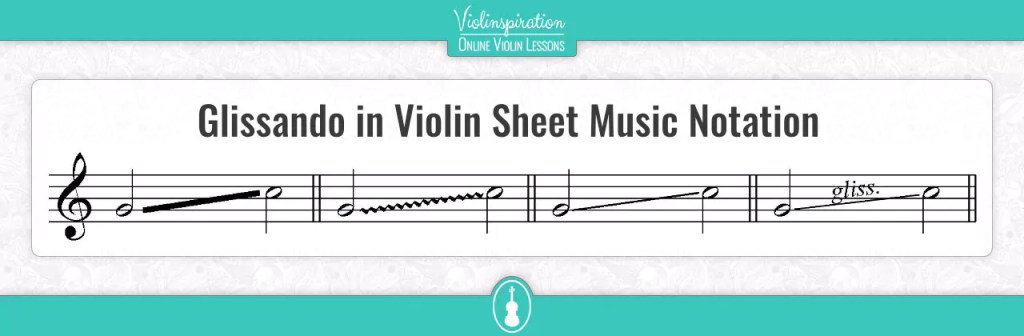
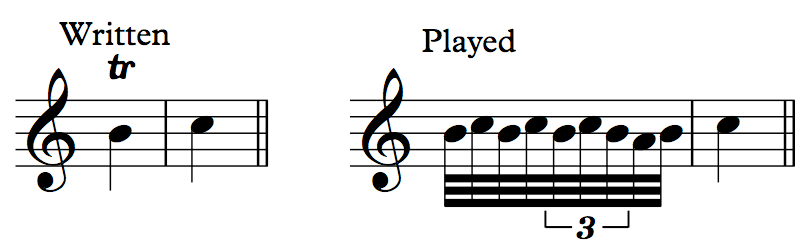
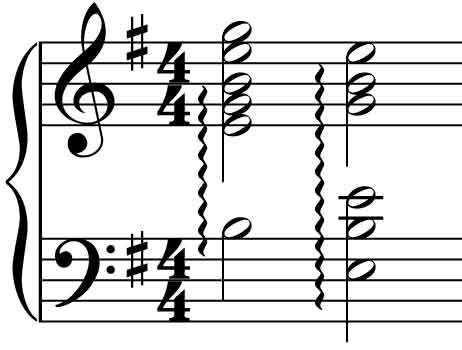
Glissando, trill, and arpeggiated chords (A): A glissando means to slide upward, typically leaving no definite note between. A trill is to go back and forth between two consecutive notes very quickly. Usually done with the second and third fingers on a piano, but fingerings can vary. There is more than one way to write the trill in the picture. An arpeggiated chord means to start from the lowest note and play lowest to highest quickly, one note at a time.
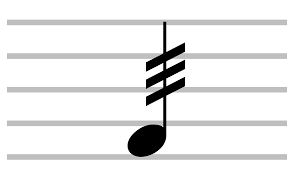
Tremolo (A): A tremolo typically occurs between two notes, usually octaves. It means to go back and forth from each note very quickly. With one note, a tremolo means to hit the note very fast over and over.
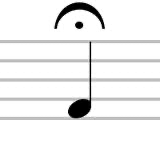
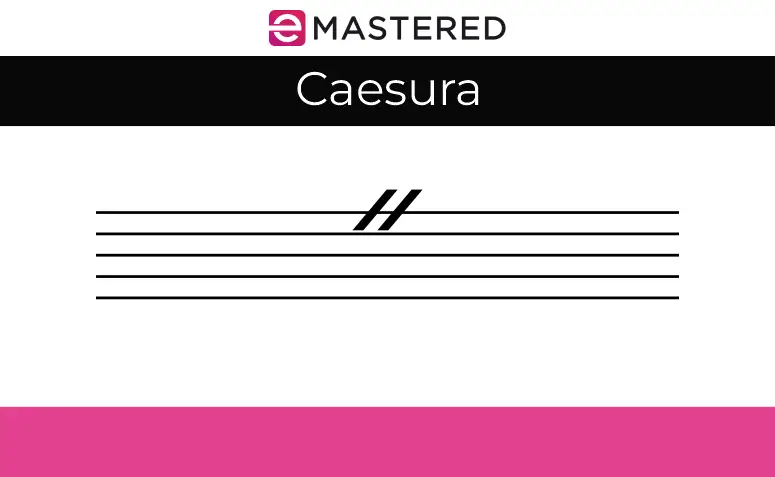
Fermata (Bird’s Eye) and Grand Pause (Caesura) (B): A fermata over a note or rest (see first above image) means to hold the note longer than its normal duration. Typically you would hold a fermata twice as long as the normal note, but if you’re in choir or a band or in general have a director, always watch them for a fermata – they can hold it as long as they want! A grand pause (see second above image) is a long break in the music, during which you must also watch your director. A caesura is basically the same as a grand pause, but typically with a shorter duration.
I hope you learned something! When I get back from vacation we will talk about some All-State vocabulary for those wanting to try out in September (again, I can’t guarantee that the times will be the same for you if you don’t live in Florida). Thanks for reading, and I’ll see you next week!
First and Second Ending photo by OnMusic Dictionary
D.S. al Coda photo by Music Jotter
Fine and D.C. al Fine photo by Music Reading Savant
Glissando photo by Violinspiration
Trill photo by 8Notes
Arpeggiated Chord photo by Music Stack Exchange
Tremolo photo by Wikimedia Commons
Fermata photo by Music Reading Savant
Caesura photo by eMastered
Cover photo by Thirdman


 The Happy Musician
Leave a comment