
Today we will learn about some dotted rhythms and what they mean in two completely different time signatures. We will only cover the single-dotted notes today, but double-dotted will come in due time. Let’s get started!
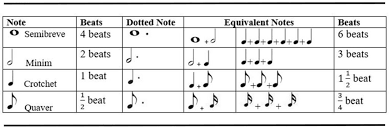
The notes above are the British names for the note types, but I will refer to them with the American versions.
First up we need to determine why a dotted note gets more beats than a regular note. A dotted note will get the usual amount of beats but adds half of the note value to the original note. Think of the dot next to the note as dividing the note in half and adding that value to what the note would be without the dot next to it. Below are the examples.
The examples below are for 4/4 time.
In the first horizontal column in the photo we have a dotted whole note and rest. As the table shows, the dotted whole note equals a whole note plus a half note. Remember that the dot takes the original value of four and splits it in half, then adds the two (from the dot) to the original four. This makes a dotted whole note six beats. This note is most commonly used in the 6/4 time signature to fill a whole measure.
In the second column there is a dotted half note and rest, most commonly used in 3/4, 4/4, and 6/8 time. The dotted half note equals two beats plus the extra one beat that the dot gives (since one is half of two), making the note three beats. As you can see, we are dividing each note by half, so you can probably guess how many beats the next dotted note gets.
For the third row we have a dotted quarter note and rest. This means that we will take the original one beat and half that and add it together to make one and a half beats!
Finally, for the last row, there is a dotted eighth note and rest. We know that a sixteenth note is half of an eighth note, so we will take the original eighth note and add a sixteenth note to make three-quarters of a beat!
The examples below are now applicable to 6/8 time.
Now we will talk about the notes in 6/8 time. We will skip the dotted whole note because that would span two 6/8 measures.
The dotted half note in 6/8 is, obviously, normally 3 beats. But in 6/8, values are typically doubled from what they are in 4/4. This means that a half note equals four beats instead of two and a quarter note gets two beats, not just one. If you put those two notes together (four beats and two beats), you get a dotted half note in 6/8 time, and it equals 6 beats (a whole measure!).
The same goes for the dotted quarter note. Since 1.5 doubled is 3, we can infer that in 6/8, a dotted quarter note gets 3 beats. Same with the dotted eighth note. Since it equals three-quarters of a beat, that number doubled is one and a half!
I hope you learned something today! Starting this Saturday until next Saturday, I will be on vacation, and anyhow I will be posting every other day now, not including Sundays. Hope y’all have a great week and I will see you Thursday!
Post photo by Phamox Music
Cover photo by Anastasia Pavlova





 The Happy Musician
Leave a comment