Hi guys! Hope y’all had a blessed Independence Day on Thursday (for all my American friends :D). Today we will look at how to count familiar rhythms in a different and even weird time signature: 6/8. First, as we recall, there are six notes in a measure, and the eighth note gets one beat. Secondly, 6/8 is known as compound duple. Compound means that the beat is divided into 3 distinct beats rather than two (don’t get beat confused with rhythm!!!). Duple is where there are two main beats, which in this case are dotted quarter notes (the two notes able to be fit evenly in a 6/8 measure). You don’t need to know that this early on.
Let’s take a look at how to count some basic rhythms in 6/8 time. Some will be explained more in depth tomorrow, when we cover the sixteenth-eighth-sixteenth note pattern and dotted notes. Let’s get to it!
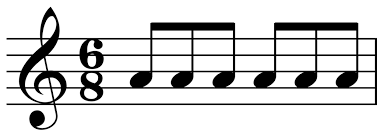
First we will discuss the rhythm above, which is just 6 eighth notes. This means that if you count to six, each number that you count will equal one of these eighth notes. This rhythm takes up a full measure, as there are six eighth notes to equal six beats. But remember, there do not have to be as many notes as beats. You can have a 4/4 signature and have one note (a whole note) per measure.
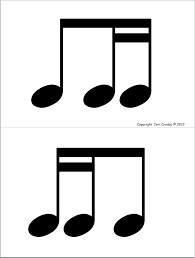
In this photo that we saw the other day, there are two sixteenth notes beamed to an eighth note. In the example we looked at in the previous post, one of these would equal one beat. Well, now they each equal two! If an eighth note gets one beat in 6/8, and a sixteenth note is half of an eighth note, then it makes sense that two sixteenth notes make an eighth note. Logically, then, it follows that in the images above there is essentially an eighth note beamed to an eighth note, and therefore (since an eighth note is one beat in 6/8, as explained before) the above would equal two beats, which takes up one third of the measure in 6/8.
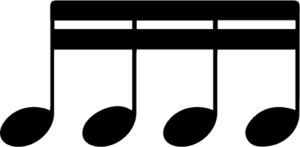
The above photo is 4 sixteenth notes beamed together. If two sixteenth notes and an eighth note equals two beats in 6/8, what do you think the notes above equal?
If you said two, you are correct! Since sixteenth notes are half a beat in 6/8, then 4 halves equal 4 divided by 2, or 2!
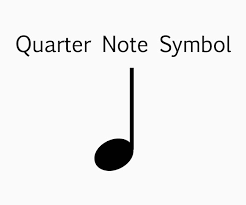
The above, as you probably know, is a quarter note. But it no longer gets one beat. It gets two. Let me explain. If two sixteenth notes equals an eighth note, a sixteenth note is considered half of a whole in this case, and four sixteenth notes equal a quarter note, then 4 halves is equal to two, so in 6/8 time, the quarter note gets two beats instead of one. An easier way to think about it is to remember the bottom number of the time signatures. If the signature is 4/4 and the quarter note gets one beat, then in 6/8, we notice that the 4 in the bottom is doubled. If we double a quarter note, we make it two beats.
We will talk about dotted notes in the next post, and then we will revisit 6/8 and dotted rhythms in 6/8 time. I hope you learned something! See you guys soon!
Post photo 1 by Liberty Park Music
Post photo 2 by Clipart Library
Post photo 3 by The New Drummer
Post photo 4 by Music Theory Academy
Cover photo by Pixabay

 The Happy Musician
Leave a comment