Today we will look at how all the past things I have talked about will combine to make a piece of music. If you haven’t read any of my other blog posts to this date, now is a great time to do that. If you already know this, then you may be ready for the individual studies and the more advanced vocabulary of music (Part one of music vocabulary releases today or tomorrow). We will start with a familiar tune to most of us, which is below.
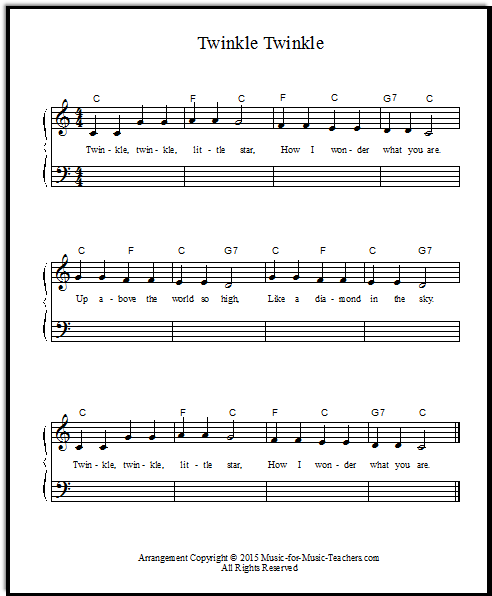
This is one of the easiest music pieces to read, as it is in the most common time signature (4/4) and is in the key of C, which is only white keys on the piano. We have already looked at two of the main things to note in this song in the previous sentence. We always need to check our time signature and our key signature to make sure we sing on time and on key!
We also notice that there is a bass clef on this music, but there are no notes. We will ignore the bass and just read the treble, since that’s all we can read.
Let’s start with the first measure. As you may remember from the first post I ever wrote on this blog (save the intro), the notes in the first measure look like quarter notes. Well, in fact, they are! In 4/4 time, quarter notes get one beat each, so if we counted to four or said “one” four times, each number (or “one”) is equal to one quarter note. We also observe repeating notes in measure one. There are two C’s and two G’s. In the next measure we go up and notice a rhythm change. The first note in the second measure is an A, and that A repeats on the second beat of measure two. Then we go back down to a G, which is a half note. A half note gets two beats, so we hold the G for as long as it takes to count to two in this tempo.
We have the same rhythm in measures 3 and 4 as we did in 1 and 2. We do have different notes, though, and the notes go down by halves and whole steps. We see the pattern of notes as follows: F, F, E, E, D, D, C. The C is a half note, so once again, we hold it for two beats.
The middle section (called a “score”) has two measures that repeat as follows: G, G, F, F, E, E, D (the D is a half note). This pattern of notes repeats twice, and then in the bottom score, the notes are the same as the first score. C, C, G, G, A, A, G; F, F, E, E, D, D, C.
Congratulations! You just read a piece of music!
I have a correction that I should have clarified in my last post, so if you want to see what I have corrected, the post will be modified on my website shortly. I hope you learned something today, and I hope that if it’s your first time reading music that you are extremely proud of yourself. Music is its own language, and it can be very tricky to read. So give yourself a pat on the back for reading one of the most complex languages on Earth! See y’all in the next (and previous, for that matter) post!
Post photo by Music for Music Teachers
Cover photo by Elina Sazonova


 The Happy Musician
Leave a comment