This is the foundation for every piece of music. In order to read and write music, you must know the basic notes. Scales are also helpful to keep in mind for a budding musician, as they will help you to get more familiar with all the musical notes there are. There are 12 notes in one octave, not including the repeated note at the top of the octave (an octave is 8 consecutive white keys on a piano), but we will only cover the first 7, and not the black keys in between quite yet. Let’s learn about notes and where they fit in the different lines and spaces on the staff.
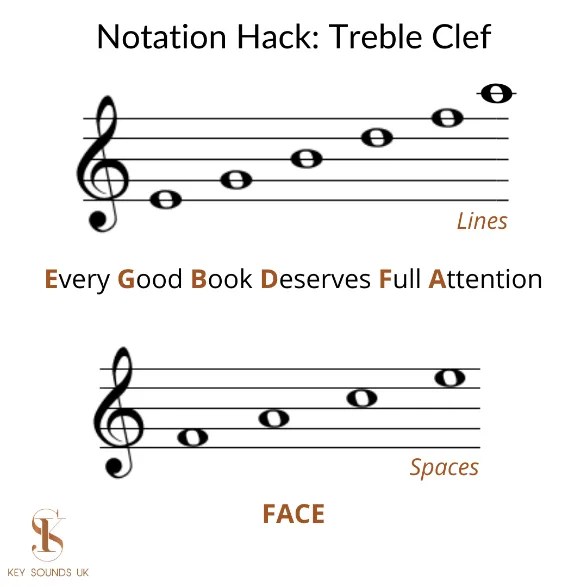
The first notes are in the treble clef, which I blogged on yesterday (see the post before this one). We will start with the basics. There are five lines and four spaces on a staff, whether the clef is bass or treble. Let’s learn the lines and spaces in the treble clef, which is the higher range of a singer or instrument (unless the instrument is low brass, strings, or reed).
There are, at the top of the first image, six notes. The first five are on the lines, so we will deal with those first. The lowest line, line 1 (the staff lines count to five from the lowest to highest line, and same with spaces), is where the E note lives. Go online and look up what the note E sounds like if you don’t already know. If you have a piano, play the white key directly after the group of two solitary black keys. The second note up is G, which is two whole steps higher than E. You can think of this as the alphabet (E,F,G). If you skip a note and go to the one above, that is two whole steps (More on this later). You may think that since the next space skips and is I, but the musical alphabet only goes from A to G. The black keys have special names but the musical alphabet doesn’t exceed G, it just repeats from A again and again!
Therefore, the third note is B. If you are on G but it goes back to A, for the lines you skip that A and go right to B. The second note to the top is D, and the top note on the line is F. But wait, you say. Why is there an extra note above the F on a line? Is it an invisible staff?
Well, in a way, it is! But it is not technically a staff. It is an extra line for a note above (in this case) or below the staff. It is called a ledger line, and it extends the range beyond the five lines and four spaces of the staff. However, it is still the line above F, so that note is A.
You can remember these notes by the acronym in the picture: Every Good Book Deserves Full Attention.
Now for the spaces. The spaces are like the lines except for the fact that they rest in between them! All the notes we skipped earlier are being filled into the lines. The lowest space on the page, F, is in space #1. The second space skips to A, the third is C, and the last is E. You can remember this by the way that these notes spell “face.”
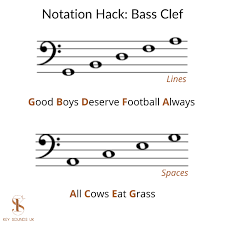
Now the bass clef, which is different than the treble clef.
The first line in the bass clef is G, the second is B, the third is D, the fourth is F, and the fifth is A. The spaces from lowest to highest are A, C, E, G. There is one more above which is B, but that sits on top of a space, and is technically to the same effect as a ledger line. A trick that I learned for the lines different than what is above in the second photo is Gummy Bears Don’t Fly Airplanes. Another trick for the spaces is All Cows Eat Grass.
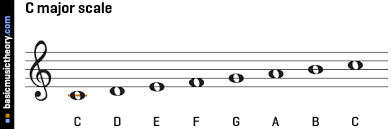
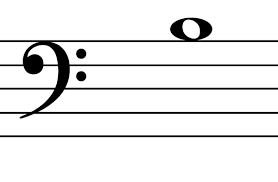
Now, let’s introduce two new notes, as shown in the last photo. The two lowest notes are similar to the A we saw earlier above the treble clef staff, and the B we saw just above the bass clef staff (but still touching it). The first and lowest note in the third picture above is C. Most people find that C is the foundation for what they sing, even though A is first in the musical alphabet. The C note here, also called middle C because it is the middle octave on a piano, is on a ledger line. The D note is right above it, hanging onto the staff on the underside, similar to the B but on the opposite side of the staff. Below for reference is a picture of the B I am talking about. See how similar it is to the D under the staff in the treble clef?
One last thing I need to mention: Every scale on any instrument (including your voice) goes in a specific order. In this following order, W equals whole step and H equals half step. The order for every scale, though not every scale has the same notes, goes like this: WWHWWWH. Take the C scale in the third picture. C to D is a whole step because a key is in between them on the piano. D to E is also a whole step for the same reason. Now be careful here. The next step in the sequence is half. E to F is a half step because there are no keys between them. F to G is whole, G to A is whole, A to B is whole, but B to C is half. If you want to know what a whole step from E or B is, that post is coming out very soon!
I hope you learned something today! On Monday we will put easy rhythms and a time signature with these notes to make familiar songs. See you guys tomorrow! (If you are still confused, be sure to comment or email me and let me know what you are struggling with.)
Post photos 1 and 2 by Key Sounds UK
Post photo 3 by Music Theory
Post photo 4 by Quiz Tree
Cover photo by Pixabay


 The Happy Musician
Leave a comment