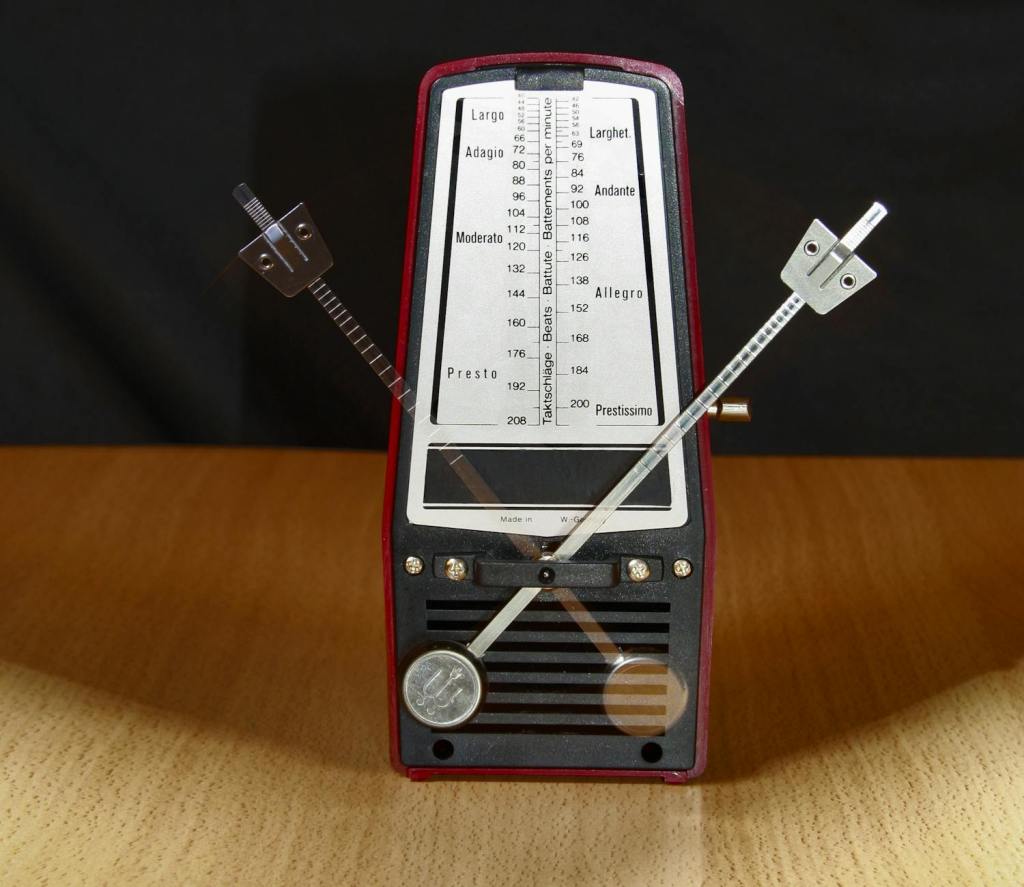
Tempo and time signature are some of the most important things to learn while reading music. Tempo means how fast you play or sing a piece, and it is usually measured in beats per minute (BPM). Time signature tells how many beats are in a measure and what note gets the beat. Let’s get to know more about different time signatures and tempos!
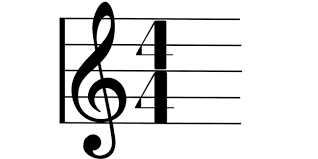
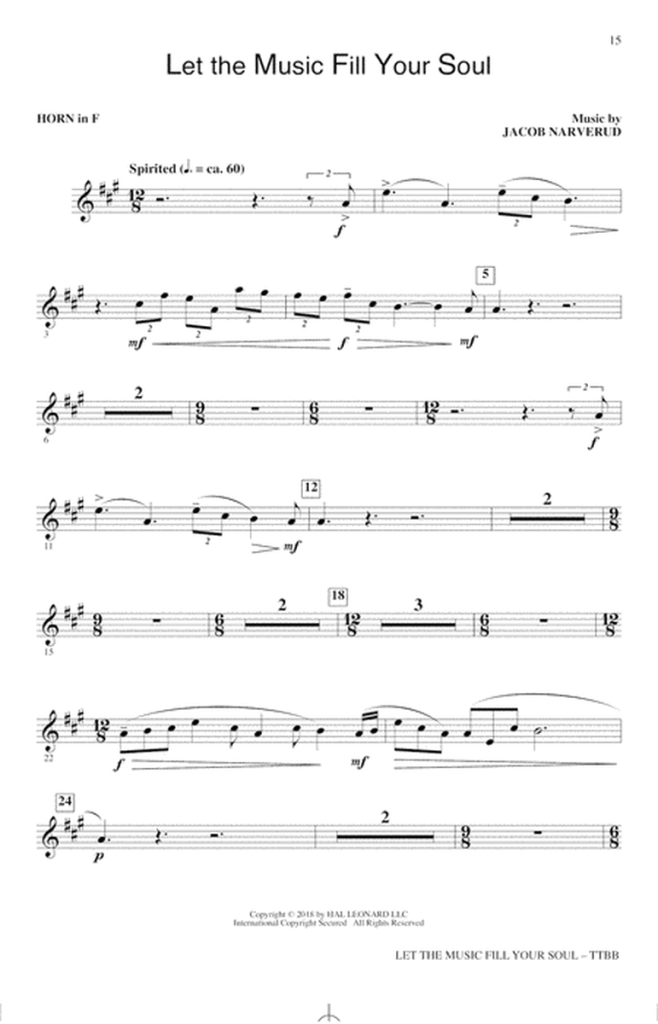
Time signature: A time signature tells how many beats are in a measure and what note gets the beat. Let’s start with the first part of a time signature, which is also the top number. In the two above examples there are each time signatures. In the first picture there is one measure that has a 4 over a 4. In the second photo, the Horn in F sheet music to the TTBB (Tenor 1 Tenor 2 Bass 1 Bass 2) “Let the Music Fill Your Soul” by Jacob Narverud, the time signature changes from 12 over 8 to 9 over 8 to 6 over 8 and back again.
In 4/4 time, as shown in photo #1, the top note of the signature tells us that there are four beats in a measure. Remember that a measure groups different notes together based on how many notes there are supposed to be in that group. This should be a fairly simple thing to grasp. However, know that there are not necessarily four notes in each measure, even if there are four beats. If, for example, you have a half note and two quarter notes in a measure, that is only three notes. And that is totally fine, since a half note (2 beats) plus 2 quarter notes (1 beat each) equals 4 beats, which is the required amount of beats for 4/4!
The bottom number of a time signature is more a little complicated to understand, so I will try to explain it simply.
The bottom number of a time signature is what note gets the beat, or, more simply, what kind of note gets one beat. We know that 4 quarter notes are in a measure in 4/4 time because there are 4 beats in a measure and a quarter note gets one beat. Now, try to follow along here. In 4/4 the quarter note gets the beat because a quarter note in 4/4 gets only one beat, as explained before.
If you had 4/2 time (which is rare), then there would be four beats in a measure, but the half note would get one beat. This means that you could fit four half notes in a 4/2 time signature measure. Likewise, since a quarter note is half of a half note, you could fit 8 quarter notes in a 4/2 measure.
Finally, let’s dissect 12/8 time. This notation means that there are 12 beats in a measure, and this time the eighth note gets one beat. This means that 12 eighth notes can fit in one measure. Since a quarter note is two times an eighth note, we can fit six quarter notes in one measure. We can also fit four dotted quarter notes (more on dotted notes in upcoming posts), three half notes, and two dotted half notes in one measure.
Tempo: This should be easier to understand, as it is simply how fast you play or sing a piece of music. The tempo names (yes, there are names to tell you how fast a piece of music goes) are in Italian, but I will tell you what they mean.
Largo: Very slow and broad.
Andante: “Walking pace,” slightly faster than largo.
Moderato: Moderate or medium tempo, faster than andante and typically above 100 bpm (beats per minute).
Allegro: Fast and rushing, faster than moderato.
Presto: One of the fastest speeds in music, much faster than allegro. Around 200-208 bpm.
Prestissimo: Faster than presto, not commonly used for the sake of the musician. I have had to play faster than this in 3/4 time – I was accompanying our middle school choir at our school in my 8th grade year and had to go 232 bpm!
I hope you learned something today! If you are still confused, you can contact me by hitting the contact link at the top of the Home Screen of this site, or you can leave a comment down below. Thanks for reading!
Post photo 1 by Simply Piano
Post photo 2 by Sheet Music Plus, music by Jacob Narverud
Cover photo by Pixabay
 The Happy Musician
Leave a comment